
Best YouTube Video Length for More Views and Watch Time: The 2026 Data for Indian Creators
There's no magic video length. But there is a formula. Learn what length works for your niche and how to build watch hours faster with the data Indian creators need.
Utkarsh Agrawal
6/9/20269 min read
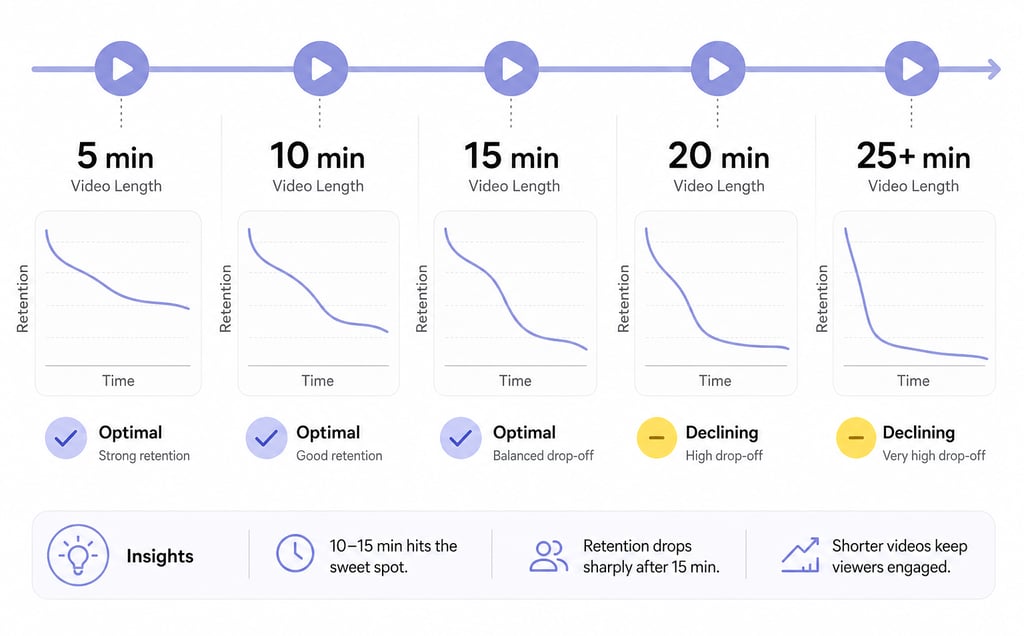
You've heard the advice: "Make your videos shorter," or "YouTube rewards longer content." Both are half-truths that leave creators stuck between two conflicting instructions. The real answer is uncomfortable because it's nuanced: there is no universal "best" video length. But there is a formula-one that depends entirely on your ability to hold attention, your niche, and whether you're chasing monetization or pure viewership.
This guide cuts through the noise with the data Indian creators need in 2026: what length actually builds watch hours, how to structure video for retention, why mobile matters, and when longer is actually better.
Why video length matters for watch hours and revenue
YouTube's core incentive is viewer time on platform. The longer viewers stay watching, the more ads YouTube sells, the more money splits to creators. This is why the algorithm pushes videos that generate high watch time.
But here's the critical distinction: watch time is not the same as video length. A 20-minute video with 40% average view duration (8 minutes watched) generates less watch time than a 10-minute video with 70% completion (7 minutes watched). YouTube measures what actually gets watched, not what's uploaded.
For monetization specifically, video length unlocks ad revenue tiers. Videos under 8 minutes get pre-roll ads (at the start) and end-roll ads (at the finish). Videos 8+ minutes unlock mid-roll ads-ads placed in the middle of your video, which YouTube can place 1 to 4 times depending on length. The jump from one to two mid-roll slots often doubles ad revenue for the same number of views, even if watch time is identical.
For 4,000 watch hours (YouTube Partner Program requirement), the math favors consistency over length. A channel uploading two quality 10-minute videos per week typically hits 4K hours faster than one uploading a single 20-minute video weekly-because two videos each reaching 60% completion stack more total hours and the algorithm pushes both into more feeds.
The retention math: length vs completion rate
Here's where most advice breaks down. Creators hear "longer videos are better" and stretch thin content to 20 minutes. Viewers bail at 5. YouTube sees that and deprioritizes the channel.
The real metric is average view duration-what percentage of your video does the typical viewer actually watch. And this is where video length becomes a genuine tradeoff.
Example 1: Gaming channel
10-minute video, 65% average view duration = 6.5 minutes watched per viewer
20-minute video, 40% average view duration = 8 minutes watched per viewer
The 20-minute video wins on total watch time per viewer. But uploading two 10-minute videos per week is more realistic than one 20-minute video per week. Two 10-minute videos at 65% each = 13 minutes total per week. One 20-minute video at 40% = 8 minutes total per week. The two shorter videos accumulate more watch hours total because they're sustainable to produce.
Example 2: Tutorial/educational
8-minute video, 75% completion = 6 minutes watched
15-minute video with padding, 50% completion = 7.5 minutes watched
Again, the longer video wins per-viewer. But many viewers searching for a quick answer bounce when they see 15 minutes. The 8-minute video reaches more people who were actually looking for what you deliver.
The retention threshold: 50%. If you cannot maintain at least 50% average view duration, a shorter video is better. Period. Below 50% completion, YouTube penalizes the video more than the extra length rewards it. Your niche and content type will have a natural ceiling for how long viewers stick around.
Optimal video length by niche (for Indian creators)
These are backed by two sources: what YouTube's own creator trends show, and what Indian creators across these niches report in community forums.
Gaming (10-20 minutes)Gamers expect long-form. Highlights, strategy talk, and gameplay clips chain into 15-20 minute videos that hold attention well because the medium naturally delivers visual novelty. The catch: you're competing against streamers who post hours. Your 20-minute highlight reel beats a 3-hour stream in the algorithm because of completion rate. Minimum 10 minutes to sustain pacing and hit mid-roll ad slots.
Educational/tutorial (8-15 minutes)Viewers come with a specific question. 8-10 minutes is the sweet spot-long enough to deliver real value, short enough that people don't fear commitment. A 12-minute video on "how to edit a YouTube thumbnail" works. A 25-minute version with extra tangents doesn't. You'll see higher completion rates on 8-12 minute tutorials than 15+ because viewers get their answer and click away satisfied, which signals completion to the algorithm.
Vlogs (12-20 minutes)Vlogging works best at 12-20 minutes because the format naturally sustains interest through narrative and personality-viewers are following you, not just information. Shorter vlogs (under 8 minutes) feel rushed and lose the storytelling that makes vlogs stick. Longer ones (20-30 minutes) work only if you have strong retention curves and can release 1-2 per week without burnout.
Finance/news commentary (8-12 minutes)News cycles and market updates have a natural pace. 8-12 minutes is the range where you can deliver context and opinion without fatigue. Longer videos (15+ minutes) on financial news feel padded unless you're doing deep dives, which are different content. Keep it tight here.
Cooking (5-10 minutes)Cooking videos have the tightest retention window. Viewers want to see the dish come together without waiting through long intro monologues or ingredient-prep padding. 5-8 minutes for quick recipes, 8-10 for moderately complex ones. Anything over 12 minutes on cooking loses viewers who just wanted the method.
Comedy/entertainment (5-15 minutes)Highly variable. Sketch comedy might be 3-7 minutes (tight punchline delivery). Comedy commentary or roasts can stretch to 15 minutes if you're keeping energy high. The rule: stop when the joke lands, not when the video reaches a time target. Padding kills comedy harder than any other format.
Product reviews (8-12 minutes)Reviewers need enough time to cover features, pros, cons, and a verdict. 8-12 minutes hits the balance-you're thorough but not endless. Longer reviews (15+) work only for big-ticket items (phones, laptops) where viewers expect depth. For most products, 10 minutes is the ceiling.
The 8-minute rule: mid-roll ads and why they change the math
This is the most underrated lever for creator revenue in India. The difference between a 7-minute video and an 8-minute video is roughly 2x the ad revenue for identical views-because 8+ minutes unlocks mid-roll ads.
YouTube allows:
1 mid-roll ad placement on videos 8-16 minutes long
2 mid-roll placements on videos 16-20 minutes
3+ on videos 20+ minutes (one every 5-10 minutes)
Depending on your audience location and niche, each mid-roll impression is worth 1.5-3x a pre-roll impression because the viewer has already committed to the video. They're less likely to skip.
For Indian creators, this is significant because your CPM (cost per 1,000 impressions) is often lower than Western creators-roughly $0.25-$1 depending on niche, vs $2-$8 in the US. The volume lever (more mid-roll slots) matters more than CPM. A 10-minute gaming video to an Indian audience with 2 mid-rolls might earn $8-15 in ad revenue. The same video at 7 minutes with only pre-roll and end-roll earns $4-6. That's the monetization gap.
Strategy: If you're close to 8 minutes-say, at 7 minutes-stretch it slightly. Add a call to action, a summary, a question for the comments. Don't pad with filler, but do use the extra 60 seconds to unlock mid-roll monetization.
Structuring videos for maximum watch time
Length alone doesn't hold attention. Structure does.
The hook rule: first 30 secondsIf you don't hook viewers in the first 30 seconds, 50%+ of them leave. This is non-negotiable across all niches. Cold open with value-don't explain who you are, don't ask for a subscribe. Show them the payoff first, then deliver.
Poor hook: "Hey, welcome to my channel. Today I'm gonna teach you about YouTube thumbnails. First, let me tell you why thumbnails matter…" (viewers already know; they clicked because they wanted to learn the how).
Good hook: "I tested 47 thumbnails last month. These 3 designs got 40% more clicks than the rest. Here's why." (viewers immediately see value and stay to learn the method).
Pattern interrupts every 2-3 minutesThe human brain resets attention roughly every 2-3 minutes. If your video is one static shot for 10 minutes, viewers zone out after minute 4. Break that cycle with cuts, new camera angles, new graphics, a question to the audience, B-roll, clips of other creators, text overlays. Anything that shifts visual focus.
This is especially important for Indian mobile viewers-smaller screens amplify the fatigue of watching the same shot. Change it up constantly.
The mobile viewer realityOver 70% of YouTube views in India happen on mobile, often in vertical orientation. Long intros-5+ minutes of talking before value-tank completion on mobile because the viewer hasn't yet committed to your channel. They're wondering if this is worth their time.
Design for mobile first: assume people are watching on a 6-inch screen in portrait mode. Massive text overlays, tight framing, fast cuts, and immediate value delivery are not luxuries-they're requirements.
Information density > length10 minutes of dense, useful content that your viewer learns from always outperforms 20 minutes of loose storytelling. Conversely, 20 minutes of genuinely new information can outperform 10 minutes of repetition. The variable isn't time-it's density. Count how many distinct ideas you're delivering per minute. Aim for 3-5 ideas per 10-minute video for educational content.
Frequency vs length: which strategy builds watch hours faster
Here's the trade-off every creator faces:
Option A: One long video per week (20 minutes, 60% completion = 12 minutes of watch time/week)
Easier to produce consistently
Simpler editing workflow
Better long-form storytelling
Smaller audience reach (one chance per week for the algorithm to push it)
Option B: Two shorter videos per week (two 10-minute videos, 70% completion each = 14 minutes total watch time/week)
More frequent touchpoints with subscribers
Higher completion rates (viewers finish what they start)
More algorithmic opportunities (YouTube pushes two videos instead of one)
More editorial decisions (two topics instead of one)
Higher production demand, easier to sacrifice quality
For hitting 4,000 watch hours in your first year, Option B wins mathematically. Two 10-minute videos at 70% each = 14 minutes. One 20-minute video at 60% = 12 minutes. Over 52 weeks, that's 728 minutes (Option B) vs 624 minutes (Option A)-an extra 104 minutes, roughly 2 hours. At scale with multiple channels or collaborators, it's noticeable.
But: This only works if you can produce two quality videos per week without burnout. If your quality drops to 50% because you're rushing, you've lost the game. One excellent 20-minute video beats two mediocre 10-minute videos every time.
Test both. Track your watch hours and completion rates. Whichever frequency lets you maintain 60%+ completion rate is your answer.
Frequently Asked Questions
What's the minimum video length to count toward YouTube's 4,000 watch hours?
There's no minimum length. Any public video counts toward watch hours, even 10-second Shorts-though Shorts don't accumulate hours as fast as long-form because the algorithm treats them separately. If your goal is hitting 4K hours fast, 8+ minutes is the real floor for longer-form content because that length can hold viewer attention better and stack more watch time per video.
Should I make two 10-minute videos per week or one 20-minute video?
Two 10-minute videos will accumulate more watch hours total if you can maintain 50%+ retention on both. The math: if you get 60% completion on a 10-minute video, that's 6 minutes of watch time. One 20-minute video with 35% completion is 7 minutes-but that completion rate is harder to maintain. Two quality shorter videos spread your risk and let the algorithm push both instead of one long bet.
Why do videos 8+ minutes earn more ad revenue?
YouTube lets creators place mid-roll ads (ads in the middle of a video) only on videos 8+ minutes long. Shorter videos get only pre-roll and end-roll, which means fewer ad impressions and less revenue per view. A 10-minute video gets up to 2 mid-roll slots; 20+ minutes can have 4 or more. That ad placement difference often doubles or triples revenue for the same view count.
Do long videos hurt my channel if viewers don't watch them all?
Only if the low completion rate signals to YouTube that your content isn't holding attention. If you post a 25-minute video and viewers drop off at 8 minutes, YouTube learns that your content only holds people for 8 minutes and pushes it less. But if you post a tight 10-minute video and 70% of viewers watch it all, YouTube sees strong completion and pushes it harder. Length is a tool, not a liability-use it only if you can sustain retention throughout.
How do I know if my video length is right for my audience?
Check your average view duration in YouTube Analytics. If viewers are dropping off after 3 minutes on a 15-minute video, your length is too long. If they're watching the whole thing plus seeking back, you could go longer. Test: post videos of different lengths and compare retention curves. Your niche and content type will reveal the sweet spot-gaming might sustain 15-20 minutes, but cooking probably maxes out at 8.
Try ytverse.in
If you're building a YouTube channel in India, watch time and retention are the metrics that matter. ytverse.in helps creators understand these numbers deeply-analyzing what's working in your niche, what length your audience actually prefers, and how to structure videos for maximum retention.
The best video length isn't a number. It's the longest video you can make where your audience stays for 70%+ of it. That's different for every creator, every niche, every audience. Tools that show you your actual retention curves-where viewers drop off, where they rewatch, where they comment-tell you exactly what to adjust next time.
Ready to optimize your upload strategy? Check out ytverse.in/youtube-algorithm-2026 for deeper insights into how YouTube's algorithm actually works in 2026, and ytverse.in/4000-watch-hours-youtube-fast for a step-by-step roadmap to hitting monetization faster.