
How to Get 1000 Subscribers on YouTube Fast: The Honest Guide for Indian Creators (2026)
Concrete tactics to hit 1K YouTube subscribers fast. Focus on niche, SEO, collaborations, and consistency - not shortcuts. Timeline and what actually works for Indian creators.
Utkarsh Agrawal
5/25/202610 min read
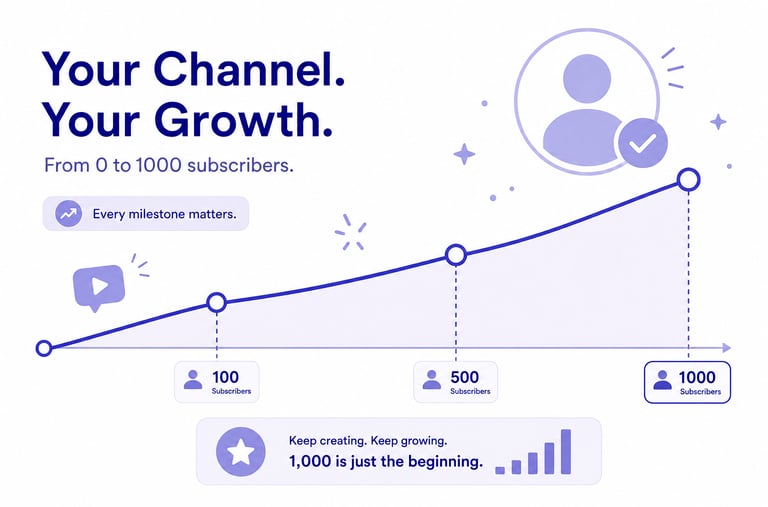
Most creators get stuck between 0 and 500 subscribers for months. They upload consistently, their thumbnails are decent, but the growth curve just flatlines. Then suddenly they either give up, or they find the right combination of tactics and hit 1K within a few weeks.
The difference isn't talent. It's strategy.
1000 subscribers is the first real milestone on YouTube. It's not just a number - it unlocks YouTube Partner Program eligibility (combined with 4000 watch hours or 10 million Shorts views), enables community posts at 500 subs to keep viewers engaged, and signals to the algorithm that people actually want your content. But getting there is a different game than getting to 100, and different again from scaling past 10K.
This guide walks through the exact moves that work for Indian creators in 2026 - not shortcuts, not grey-area tactics, just what the data says actually converts viewers to subscribers.
Why 1000 subscribers is harder than it looks (and easier than you think)
Here's what makes 1K deceptively tricky: you need specificity. A generic "tech reviews" channel that uploads every other week might never hit 1K. A "iPhone reviews in Hindi for budget shoppers" that uploads weekly will. One niche down, one upload schedule locked in, and suddenly growth becomes predictable instead of random.
The "easier than you think" part comes once you stop betting on virality. Channels obsessed with one viral video waste months. Channels that optimize for small, consistent wins - collaborations every month, YouTube search traffic, Shorts as a funnel - hit 1K methodically.
Most Indian channels that do this right reach 1K in 6-12 months. Some do it faster. The real variable isn't luck. It's whether you've picked a niche narrow enough to own.
Step 1: Lock in your niche (the narrower, the faster)
This is the make-or-break move. A broad niche kills growth. A narrow one accelerates it.
"Tech reviews" loses to "iPhone reviews in Hindi for students under Rs 30,000."
Why? Because YouTube's algorithm matches viewers to channels based on intent. A student looking for a budget iPhone review will find your channel in search results if you're specific. They'll skip a generic "tech review" channel that covers everything. And once they subscribe, they stay subscribed because every new video is for them.
Subscription conversion works differently at different niche levels:
Broad niche ("tech"): 0.5-1% of viewers subscribe. Most people watch one video and leave.
Medium niche ("iPhone reviews"): 2-3% subscribe. You're closer to their needs.
Narrow niche ("budget iPhone reviews for Indian students"): 8-15% subscribe. You're solving their exact problem.
That conversion rate multiplied across uploads adds up fast.
Start by answering three questions:
What problem do I actually solve (or what do I create entertainment around)?
Who is my exact target person (age, income, language preference, pain point)?
What do they search for on YouTube?
Write these down. If you can't answer all three specifically, your niche is still too broad.
Then validate: search your niche on YouTube. Look at channels with 50K-500K subscribers. They're the "just-right-sized" competition - not so big that the niche is saturated, not so small that there's no audience. If you can't find 3-5 channels doing something similar, your niche might be too narrow (no audience). If there are 500+ channels doing exactly what you want, it's too broad.
Step 2: YouTube SEO - Get found before you're famous
One of the fastest ways to grow is being discoverable through YouTube search. This works because search traffic is intent-rich - someone typing "how to make money on YouTube in India" is actively interested. You just need to be the answer.
YouTube SEO has three levers: keywords, titles, and descriptions.
Keywords first. Find search terms your niche audience uses. Tools like TubeBuddy and VidIQ exist for this, but you can also just search your niche on YouTube and look at the autocomplete suggestions. "Personal finance" + autocomplete shows "personal finance for beginners," "personal finance tips," "personal finance in Hindi" - these are real searches with intent.
Titles. Include your target keyword naturally. "How to Invest Rs 500 Every Month (Beginner's Guide to Personal Finance)" beats "Personal Finance Tips #47." The first is SEO-optimized and informative. The second is invisible.
Descriptions. Write 3-5 sentences with the keyword in the first sentence. Viewers rarely read descriptions, but YouTube's algorithm definitely does. Link to related content from your channel - this keeps watch time up.
The payoff: evergreen content (videos that answer the same question for months) compounds. A video you upload today targeting "how to start a YouTube channel in India" will pull new subscribers in month 2, month 5, month 12. Viral videos give one-time spikes. Evergreen SEO content gives steady baseline growth.
Learn more about optimizing for YouTube search.
Step 3: The first 100 subscribers (different tactics than 100-1000)
Getting to 100 is the hardest part - it feels thankless because you're uploading to an empty room.
But the tactics here are different. You're not optimizing for YouTube's algorithm yet. You're optimizing for people who know you to become subscribers.
Your first 50 subs probably come from friends and family. Tell them. Drop a message in your college group chat, your family WhatsApp, your friend circle. Make it easy - link directly to your channel, not your latest video. You want them to subscribe, not just watch one video.
The next 50 come from cross-promotion. Do you have an Instagram, Twitter, TikTok? Post clips from your videos. Post behind-the-scenes content. Tell people you have a YouTube channel. If you have an audience anywhere else, the conversion to YouTube subscribers is surprisingly high.
Then: comment on other channels in your niche. Leave real, specific comments on videos from channels with 5K-100K subscribers. Not "great video bro" - actual thoughts that show you engaged with the content. Include your channel name (not as a link, just your name). A small fraction will click through and potentially subscribe. It's slow, but it works. Most channels do this for 2-3 weeks and give up. If you do it consistently for 2-3 months, you build a small audience.
Once you're at 100, YouTube's algorithm starts helping. Your videos get shown to more people who aren't already subscribed.
Step 4: Collaboration strategy for rapid growth
Collaborations are the single fastest organic way to jump from 100 to 1000 subscribers.
Here's how this works: you partner with another creator in your niche with a similar subscriber count (or slightly higher). You appear in each other's videos. Their audience meets you, some subscribe. Your audience meets them, some subscribe to them. Both channels win.
The size match matters. Collaborating with someone at 500 subs when you're at 100 is perfect. Collaborating with someone at 100K is useless - their audience won't remember your small channel. Collaborating with someone at 50 subs has no leverage.
How often? Monthly is a good cadence. Too frequent looks spammy; too infrequent doesn't compound.
What format?
Interview/conversation style: You both sit and talk for 20-30 minutes. Low production, high engagement.
"Debate/comparison" videos: You disagree on something and hash it out. Opinions drive engagement.
Reaction to each other's content: Simple and effective for growth.
Guest appearance in your format: They join your normal video style.
Start reaching out to creators at your level. Say something genuine - mention a specific video of theirs you liked, explain why a collaboration makes sense, suggest a concrete format. Most will say yes.
One collaboration per month, consistently, gets you from 100 to 500 subs. Multiple collaborations per month gets you from 500 to 1000.
Step 5: Shorts as a subscriber funnel
Shorts are the funniest part of YouTube growth in 2026 - they can bring thousands of subscribers in days, but retention is unpredictable. The key is treating them as a funnel, not a destination.
A viral Short gets views - maybe 100K+. But a small percentage of those viewers go to your channel. Of those, an even smaller percentage subscribe. But at scale, it works.
Here's the move: optimize your channel page. Your channel banner and about section need to immediately tell non-subscribers why they should subscribe. "Budget phone reviews in Hindi" is clear. "Tech stuff" is not.
Then: link from Shorts to your long-form content in the descriptions. A viewer watches your Short about "How to find the best budget phone under Rs 15,000." They think "huh, that's useful." They click your channel. They see you have a full 12-minute deep-dive video on the same topic. They watch it. Then they subscribe.
This funnel turns one viral Short into sustained growth.
Post Shorts 2-3x per week. Most won't blow up, but the ones that do will send spikes of subscribers into your long-form videos. And long-form videos are where people actually decide to subscribe - the value is deeper, the commitment is higher.
See our guide on YouTube growth in India for more on using Shorts effectively.
Step 6: Channel optimization (the things everyone skips)
Your channel page is a landing page. A non-subscriber lands there and decides in 5 seconds whether to subscribe. Most creators ignore this and lose 40% of potential subs.
Channel trailer: You get 60 seconds. Use it. Show your best 30 seconds of content with a hook ("If you care about personal finance, stay"). Make it punchy. Most people skip the rest of your about section but they watch a good trailer.
About section: 150-200 characters max. Describe who this channel is for, not what you make. "Budget iPhone reviews for Indian students" works. "iPhone reviews and tech stuff" doesn't.
Playlists: Group your videos by topic. If someone lands on your channel interested in "how to start investing," don't make them scroll - show them a playlist of 5-10 investing videos immediately. Playlists increase session watch time and give non-subscribers more reason to stay.
Thumbnails: Consistency builds brand recognition. Pick a color (use ytverse's lavender purple #9398CD if you like), stick with it. Bold sans-serif font. A face showing surprise or focus. Same layout every time. After 20 videos, subscribers recognize your thumbnails in their feed and click without reading the title.
End screens and cards: Every video should have a subscribe card in the final 10 seconds. A well-placed subscribe CTA lifts subscription rate by 15-20% on relevant content. Use it.
What NOT to do
Four things that sound like they'll work but actually hurt your channel:
Sub4sub. "Subscribe to me, I'll subscribe to you." YouTube detects low-engagement subscriber swaps in the algorithm and suppresses your videos in recommendations. The subscribers you gain this way almost never watch your videos. Your watch time drops. The algorithm tanks your reach. Avoid it entirely.
Buying subscribers. Same result as sub4sub but worse. YouTube detects the inorganic traffic pattern, and your videos get suppressed. You'll feel like the algorithm hates you. It does - because the signal is broken.
Uploading too frequently then stopping. The algorithm weights consistency heavily. A channel uploading 1 video per week, every week for a year, outperforms a channel uploading 10 videos in month 1 then going silent. The algorithm expects frequency. Break the pattern and it assumes you've quit and stops promoting your videos to anyone.
Clickbait titles without substance. Titles like "YouTube EXPOSED!" or "You WON'T BELIEVE What Happened" get clicks but viewers leave fast when the video doesn't deliver. YouTube measures average view duration - if it's low, the algorithm stops promoting that video. Write honest titles that set expectations you actually meet.
Realistic timeline for Indian creators
Here's what actually happens, month by month, if you execute this guide:
Months 1-2: 0 to 100 subscribers. You're building from zero. Friends and family. Early comments. No algorithm help yet. This part is slow and demoralizing.
Months 3-4: 100 to 300 subs. First collaboration happens. YouTube starts showing your videos to small segments of non-subscribers because of improved watch time. Growth becomes visible.
Months 5-7: 300 to 700 subs. Second and third collaborations. Evergreen SEO videos start accumulating views from search. One or two Shorts go moderately viral. Growth accelerates.
Months 8-12: 700 to 1000+ subs. You're hitting critical mass. Each new video reaches more people. Collaborations are with bigger creators now. One viral Short sends a spike of new subscribers. You cross 1K.
This assumes consistent execution - weekly uploads, one collaboration per month, YouTube SEO applied to every video, Shorts posted 2-3x weekly. If you're spotty or stop for months, add 4-6 months to the timeline.
Some channels beat this (especially if they're in a hot niche or have an existing audience elsewhere). Many take longer. But this timeline is realistic and achievable if you don't wait for perfect and instead start with what works.
Why this matters (and what comes next)
1000 subscribers is the first real proof that your channel works. It says your content solves a problem or entertains a specific group of people well enough that they come back. The tactics don't change much after 1K - you just double down on what got you there - but the psychology does. You stop wondering if anyone cares. You know they do.
Learn more about scaling beyond 1K and hitting 4000 watch hours at the same time.
Try ytverse
If you're building a YouTube channel from scratch, the process is straightforward but grinding. Every decision - niche, collaboration partners, content pillars, thumbnail design - compounds over months. The framework above works, but having someone who's done this 100+ times review your strategy, audit your channel, and keep you accountable makes the difference between 12 months to 1K and 5 months.
ytverse works directly with Indian creators to accelerate growth. They audit your niche choice, help you find collaboration partners, set up your SEO fundamentals, and build a calendar that actually converts subscribers. Most creators they work with hit 1K in 4-6 months instead of the 12-month grind. Worth exploring if you're serious.
Frequently Asked Questions
How long does it actually take to get 1000 YouTube subscribers?
Most Indian channels that consistently upload reach 1K in 6-12 months. Speed depends on niche selection and collaboration strategy - niche focus significantly shortens this timeline. Channels that prioritize collaborations often hit 1K in 4-6 months instead.
Is buying YouTube subscribers worth it?
No. YouTube's algorithm detects low-engagement subscribers from purchasing services and actually penalizes your channel. Your videos will get suppressed in recommendations. Focus on organic growth via SEO and collaborations - it's slower upfront but sustainable.
Do YouTube Shorts help you get subscribers faster?
Yes, but with a catch. Viral Shorts can add thousands of subscribers in days, but retention is lower - you need a strong funnel from Shorts to long-form content. A strategy that treats Shorts as a discovery funnel works best.
What niche has the fastest subscriber growth in India?
Personal finance in regional languages, mobile gaming, DIY/crafts, cooking, and study vlogs have the fastest growth in 2026. The more specific your niche, the faster your growth - 'Tamil personal finance for beginners' outperforms 'personal finance' every time.
Should I focus on watch hours or subscribers first?
YouTube monetization requires both 1000 subscribers AND 4000 watch hours combined, but they don't grow at the same rate. Focus on subscriber growth with engaging niche content first, then optimize for watch time once you have momentum.