
How to Get Brand Sponsorships with Under 1000 Subscribers in India - A Real Guide
Real steps to land brand deals as a micro-creator in India. With under 1000 subscribers, you can still get sponsorships-here's exactly how.
Utkarsh Agrawal
6/21/202612 min read
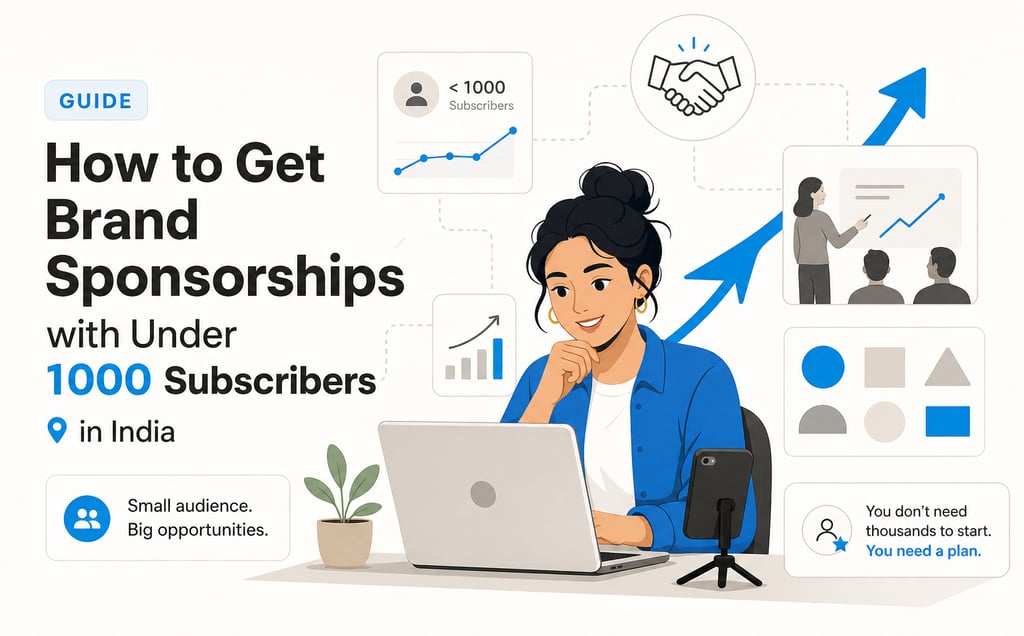
Micro-creators with under 1000 subscribers can absolutely land brand deals in India-here's how:
Brands care more about engagement rate and audience quality than follower count; a 5% engagement rate at 500 subs often beats 2% engagement at 5000.
Pitch first. Most deals happen because the creator reached out, not the other way around. Brands don't know you exist until you tell them.
Start with affiliate programs (Amazon, Flipkart, Meesho-zero minimum subs) to build income and proof of audience conversion ability. This makes brand sponsorships easier to land later.
Rates for micro-creators in India: ₹1K–₹10K per video under 5K subs; ₹10K–₹50K at 5K–50K subs. Negotiate based on engagement, niche, and audience demographics.
Use templates for pitches (below), always ask for a written agreement, and disclose sponsorships via #ad or #sponsored per ASCI rules.
Real Indian creators have landed sponsorships at 300, 500, 1000+ subs. You can too-you just have to ask.
Why brands actually work with small creators-and why you should know this
The first thing most creators get wrong is thinking "I need 10,000 subscribers before any brand will touch me."
Wrong.
Here's what brands actually care about: Can this creator's audience buy my product? Subscriber count is just one part of that equation. A creator with 800 subs but 8% engagement rate in the beauty space is way more valuable to a cosmetics brand than a creator with 15,000 subs and 0.5% engagement.
Why do brands work with small creators?
Niche audiences are gold. A brand selling tech accessories doesn't want a general lifestyle creator with 50K followers. They want someone with 2K followers who are all genuine tech nerds. The niche matters infinitely more than the number.
Engagement rates tell the truth. An engaged audience of 500 means each video reaches real people. A ghost audience of 10K means your videos disappear into the void. Brands would rather have real influence over big numbers.
Micro-creators are affordable. Brands have smaller marketing budgets than you think. Working with 5 creators at ₹5K each (₹25K total) is a legitimate strategy. One big influencer at ₹50K might not deliver the same ROI.
Trust and authenticity. Smaller creators often have deeper relationships with their audiences. People listen to micro-creators like they listen to friends. That trust translates to higher conversion on sponsored products.
Real example: One tech reviewer on Reddit got his first sponsorship from a phone accessories brand at 500 subs. Why? Because his audience was 100% people interested in phones. The brand didn't care that 9,500 creators were bigger. They cared that these 500 people would actually buy.
The hard truth: If you have zero sponsorship inquiries, it's not because you're too small. It's because brands don't know you exist. You have to tell them.
What to prepare before reaching out to any brand
Before you send a single pitch, you need three things in place:
1. A media kit (one-page PDF or Google Doc)
Your media kit is your resume. Brands look at it for 30 seconds, so make it count.
Include:
Your name and niche (e.g., "Tech reviewer | Indian tech audience")
Channel stats: Subscribers, average views per video, upload frequency
Engagement metrics: Average engagement rate (comments + likes + shares / total views × 100), audience retention %
Audience demographics: Age range, location (% India), interests, income level if known
Past collaborations (if any): Brand logos or names of brands you've worked with
Content examples: 3-5 recent video thumbnails or links
Contact info: Email, Instagram, phone number
Rates: What you charge per video (you'll adjust per deal, but having a starting point helps)
Keep it to one page. A 10-page media kit gets ignored. Canva has free templates; use one of those.
Save as PDF and put the link in your Instagram bio: "Collaborations: [bit.ly link to media kit]"
2. Channel audit: Know your own numbers cold
Brands will ask:
"What's your average view count?"
"What's your engagement rate?"
"What's your audience demographic?"
If you don't know the answer in 2 seconds, you look unprepared.
Go to YouTube Studio → Analytics and note down:
Subscribers: Total count
Average views per video: Last 30 days total views / number of videos
Engagement rate: (Total likes + comments last 30 days / total views last 30 days) × 100
Top demographics: Age, gender, geography (% India)
Top audience interests: YouTube will show these
Write these down. Update quarterly.
3. Niche clarity: Be specific about what you do
"I make videos" ≠ pitch.
"I make 8-minute breakdowns of Indian music production software and hardware, targeting music producers and hobbyists in India" = pitch that works.
Specificity helps brands self-select. A brand selling beauty products won't contact a tech reviewer, but a tech reviewer might get contacted by a phone brand, an app, a VPN service, or a laptop brand-all because the niche was clear.
Write down:
What topic do I cover? (Tech, beauty, lifestyle, education, gaming, etc.)
Who is my ideal viewer? (Age, interests, profession, problems they have)
What problems do I solve for them? (Reviews? Tutorials? Entertainment?)
This clarity is what transforms "I'm too small" into "I'm the perfect niche fit."
How to find Indian brands that actually work with small creators
You don't have to wait for brands to find you. You go find them.
Method 1: Direct brand outreach (best for niche fit)
List brands relevant to your niche. For each, find the email or Instagram handle for partnerships or influencer marketing.
Where to find contact info:
Instagram: Search the brand, go to their profile, look for "Contact" or "DM" buttons (many brands link to business email in bio)
Website footer: Most brands list "Partnerships" or "Brand Collaborations" in the footer with an email
LinkedIn: Search the brand's main account, find the social media manager or marketing head, reach out to them directly
Twitter/X: Follow the brand account, find posts about influencer partnerships, or DM their account asking for partnership contact
Method 2: Affiliate programs first (lowest barrier to entry)
Affiliate programs are the easiest entry point. You promote, earn commission, build proof of conversion ability, then brands take you seriously for sponsorships.
Top affiliate programs for Indian creators:
Amazon Associates India - 2–20% commission per category, 1M+ products. Instant or 24h approval. Minimum ₹100 balance to withdraw.
Flipkart Affiliate - 2–20% commission, India-focused, fastest approval (24 hours), easy dashboard.
Meesho Creator Program - ₹25–₹50 signup bonus, 2–15% commission, zero minimum followers. Reseller model (you buy products at discount, resell).
CJ Affiliate - Global network, 2–50% commission, 4,000+ brands, dedicated account manager.
ShareThis - CPM + revenue-share model, instant access, no approval required.
Start with Amazon or Flipkart. They're easier to approve and you'll build ₹10K–₹50K/month income within 3-6 months if you're consistent. That track record makes brands willing to pay for sponsorships.
Method 3: Creator platforms
Platforms like Creator.co and Influencer.in connect creators with brands. However, most require 5K+ followers to get meaningful opportunities. Useful to join, but not your primary path as a micro-creator.
Email and DM pitch templates (Indian context)
The pitch is where most creators fail. They're generic, half-hearted, or awkward. Here's how to write one that actually works.
Email pitch template
Subject: Partnership opportunity - [Your channel name] ([Your niche])
Hi [Brand marketing manager name],
I'm [Your name], and I run a YouTube channel focused on [specific niche] with [X subscribers] and [Y%] engagement rate. My audience is primarily [target audience description], based mostly in India.
I've been following [Brand] for a while and think [specific reason you like their products]. I believe my audience would genuinely value your [specific product/service].
I'd like to explore a collaboration. Here's what I can offer:
[X-minute video/series covering your product]
[Where you'll promote it: YouTube description, community post, Instagram, etc.]
[Turnaround time: e.g., "published within 2 weeks"]
My media kit is attached. I'm happy to discuss rates and terms that work for both of us.
Looking forward to hearing from you.
Best, [Your name] [Your email] [Your phone or Instagram handle]
Why this works:
✅ Specific (mentions their product, not generic)
✅ Credible (you included media kit and numbers)
✅ Clear (says exactly what you'll deliver)
✅ Professional (no emojis, one paragraph per idea)
DM pitch template (Instagram/Twitter)
Hi [Brand handle], I run a [niche] channel with [X] subscribers and [Y%] engagement rate. My audience is [target demographic]. I'd love to collaborate on a video/post featuring [your product]. Interested? I'll send my media kit.
Why DMs are riskier: Brands get hundreds of DMs daily. Email is more likely to reach someone. But DMs work if:
The brand has a "DM for collaborations" note in bio
The account is small enough to actually read messages
You're reaching out to an account that recently posted about influencer partnerships
Send pitch to 10-20 brands. You'll probably get 1-2 responses. That's normal.
The golden path: Affiliate marketing as your bridge to sponsorships
Here's a secret that actually works: Use affiliate marketing to prove your value, then leverage that proof to get sponsorships.
How the progression works:
Month 1-3: Build affiliate income (₹0–₹10K/month)
Join Amazon, Flipkart, Meesho
Promote relevant products in video descriptions and community posts
Track clicks and sales in your dashboard
You're building a portfolio of "this creator drives real sales"
Month 3-6: Reach out to affiliate brands with proof (₹10K–₹50K/month)
Show brands your affiliate stats: "I drove ₹50,000 in sales for Flipkart in 3 months"
Brands see hard numbers. They like hard numbers.
Brands will now hire you for sponsorships at higher rates because you've proven ROI
Month 6+: Sponsorships + affiliate hybrid (₹50K–₹500K/month)
You're now getting 5-10 sponsorship offers per month
You can pick the ones that fit your audience
You're also running affiliate alongside sponsorships (no conflict)
Real example: One gaming YouTuber started affiliate marketing at 200 subs. After 4 months of consistent promotion, he had ₹35K affiliate income to show brands. His first sponsorship came at 800 subs-₹15K per video-because he could prove his audience converted.
The affiliate → sponsorship bridge isn't accidental. It's a deliberate path most successful micro-creators take.
How much should you charge? Rates for micro-creators in India
This is where creators get it wrong. They either:
Charge too little (₹1K for a video when they should ask ₹5K)
Charge too much (₹50K when they're at 2K subs and 1% engagement)
Don't charge at all (because they're scared or don't know how)
Here's a rate breakdown for Indian creators:
By subscriber tier
Subscribers
Per-video rate (₹)
Notes
100–500
₹1K–₹2K
Affiliate programs only; direct sponsorship rare
500–1K
₹2K–₹5K
First sponsorship tier; mostly product trades or low rates
1K–5K
₹5K–₹15K
Sweet spot for micro-creators; brands start taking you seriously
5K–10K
₹15K–₹30K
Mid-tier; stronger negotiating position
10K–50K
₹30K–₹100K
Established creator; multiple offers per month
50K–100K
₹100K–₹250K
Professional creator; premium rates
By engagement rate
If your engagement rate is above 5%, you can charge 50% more than the chart above. If it's below 2%, charge 50% less or focus on building engagement first.
Example: 3K subscribers, 6% engagement rate.
Base rate for 1K–5K subs: ₹5K–₹15K
6% engagement bonus: +50%
Actual rate: ₹7.5K–₹22.5K per video
By niche
Higher-paying niches: Tech, finance, business, beauty (brands have bigger budgets) Lower-paying niches: Education, lifestyle, vlogging (brands have smaller budgets)
Tech reviewers can charge 2x more than education creators at the same subscriber level. It's not fair; it's just the reality.
Negotiation tips
Quote a range, not a fixed price: "₹5K–₹10K per video depending on scope" gives you room to negotiate up.
Factor in extras: If a brand wants you to also promote on Instagram and YouTube community, charge more.
Lock in multiples: Offering a discount for 3+ videos ("3 videos for ₹12K instead of ₹15K") gets brands to commit.
Don't negotiate down more than 20%: If a brand asks you to cut rates by 50%, walk away.
Most important rule: Never do a deal "to build my portfolio." Your first 5 sponsorships should pay real money (₹2K minimum, even if it feels small). Free deals train brands to expect free work. Paid deals train them to value you.
Real Indian creators who landed sponsorships early (and how)
Case study 1: Photography reviewer (500 subs)
Niche: Camera reviews and photography tutorials Starting subs: 450 First deal: Canon camera brand (inbound-they found him) How: High-quality reviews, consistent upload schedule, niche audience of photographers
Lesson: Brands find you when your content is undeniably good for a specific niche. Polish wins.
Case study 2: Tech gadget unboxer (1K subs)
Niche: Budget tech reviews for students Starting subs: 600 First deal: Phone accessories brand (cold outreach via email) Rate: ₹3K per video (negotiated from initial ₹2K offer) How: Built a list of 30 relevant brands, sent personalized pitches to 15, got 2 responses, closed 1 deal
Lesson: Outreach works. Most creators don't try because they fear rejection.
Case study 3: Beauty influencer (800 subs)
Niche: Budget makeup tutorials for Indian women Starting subs: 300 First deal: Meesho affiliate (₹500/month), then brand sponsorship at 800 subs Brand: Indian beauty startup Rate: ₹5K per video (negotiated from ₹3K) How: Started with affiliate to build credibility, reached out to 20 indie beauty brands, 3 responded
Lesson: Start with affiliate for proof of concept, then move to direct sponsorships with stronger negotiating power.
Case study 4: Education channel (2K subs)
Niche: Engineering exam prep in Hindi Starting subs: 800 First deal: Online course platform (sponsorship + affiliate hybrid) Rate: ₹10K per video + 10% commission on sales How: Audience was highly targeted; brand found them through YouTube search. No outreach needed.
Lesson: Hyper-niche channels get found by brands because the relevance is so obvious.
Featured snippet: How to get brand sponsorships with under 1000 subscribers
Create a media kit with subscriber count, engagement rate, audience demographics, and rates. Update quarterly.
Start with affiliate programs (Amazon, Flipkart, Meesho) to build proof of audience conversion ability.
Build your niche clarity - be specific about your topic and target audience. Brands self-select based on specificity.
Make a list of 20 relevant brands and find their partnership email address or Instagram contact.
Send personalized pitches to each brand. Generic emails get deleted; personalized ones get read.
Include your media kit with every pitch. No media kit = no credibility.
Expect "no" more than "yes" - a 10% response rate (2 replies from 20 pitches) is normal and good.
Negotiate smartly - don't charge too little, but don't price yourself out either.
Always ask for a written agreement - email, Google Doc, or contract. Verbal agreements disappear.
Disclose sponsorships properly - use #ad or #sponsored in the description per ASCI rules.
Affiliate marketing as income diversification
While you're pursuing sponsorships, affiliate marketing is your steadiest income stream. Most successful micro-creators run affiliate + sponsorship in parallel.
Affiliate programs (Amazon, Flipkart, Meesho, ShareThis) can earn you ₹10K–₹50K/month at 1K–5K subs if you're consistent. That's real money that funds equipment, better audio, editing software-all things that make your channel better.
Read our full guide to affiliate marketing for YouTube creators to understand commission structures, promotion strategies, and how to stack multiple programs for maximum income.
What happens after you land your first deal
Deliver exceptional content. Over-deliver on quality. This brand might hire you again or refer you to others.
Track results. Ask the brand for metrics: video views, clicks to their site, sales driven. These metrics become proof for the next brand.
Ask for a testimonial or reference. "Can I mention on my media kit that I worked with your brand?" Most brands say yes.
Keep the relationship warm. Stay in touch-"Hey, I just hit 2K subs, might be a good time for another collaboration?"
One sponsorship deal usually leads to 2-3 more within the next month. Momentum builds.
Income diversification: Building beyond sponsorships
Sponsorships alone aren't enough-especially at small subscriber counts. The most successful creators diversify:
Affiliate marketing (40% of income): Amazon, Flipkart, Meesho
Sponsorships (30%): Direct brand deals
YouTube AdSense (15%): Ad revenue once monetized
Digital products (10%): Courses, presets, digital downloads, Patreon
Channel audit services (5%): Coaching other creators in your niche
Read our guide on income diversification strategies to build multiple revenue streams so you're not dependent on any single source.
Try ytverse.in
If you're serious about monetizing your YouTube channel, ytverse.in helps Indian creators hit monetization milestones faster. They specialize in YouTube SEO, subscriber growth, and watch-hour acceleration-exactly the foundation you need before approaching brands.
Brands are more likely to partner with creators who have:
Consistent upload schedule
Strong YouTube SEO (searchable videos)
Good channel health (retention, engagement)
ytverse's data-driven approach addresses all three. They've helped creators go from 0 to 1000 subs in 3-4 months, and from 1000 to 10K subs in 6 months. With that trajectory, sponsorship offers follow naturally.
Frequently Asked Questions
Can I get brand deals with less than 500 subscribers?
Yes, but it's harder. Most brands ask for at least 500-1000 followers as a starting point. However, if your engagement rate is above 5% and your audience is highly targeted, some brands (especially micro-brands and affiliate programs) will work with you at 100-300 subs. Start with affiliate programs first to build proof of audience quality.
Should I reach out to brands or wait for them to contact me?
Always reach out proactively. Brands rarely find micro-creators on their own. Create a media kit, identify 10-20 relevant brands in your niche, and send personalized pitches via email or Instagram DM. This is how most deals under 1000 subs happen. The creator who pitches gets the deal; the creator who waits doesn't.
What if a brand asks me to send them free content first?
Red flag. Legitimate brands don't ask for free trials or "samples" before hiring you. They may send you a product to review (free product, which is fair), but they should pay for the actual content creation and promotion. If a brand is unwilling to pay, move on-your time has value.
How do I know if a brand sponsorship offer is fair?
Compare to the rate ranges for your subscriber tier (see the rates section below). Under 5K subs, expect ₹1K–₹10K per video. If an offer is 50% lower, negotiate. If it's 80% lower, walk away. Also check: Do they require exclusive content? How long before you can make similar videos for competitors? Are they asking you to violate YouTube or Indian regulations?
Do I need a formal contract for brand deals?
Yes. Even a simple written agreement over email works. Document: payment amount, delivery date, content specifications (video length, mentions, CTAs), exclusivity period, and when payment is due. This protects both you and the brand. If a brand refuses to put terms in writing, don't work with them.