
How to Grow Your YouTube Channel in India in 2026: The Step-by-Step Playbook
India's YouTube market demands a different growth strategy. Learn the 3-phase playbook built for Indian creators - from niche selection to scaling beyond 100K.
Utkarsh Agrawal
6/2/202612 min read
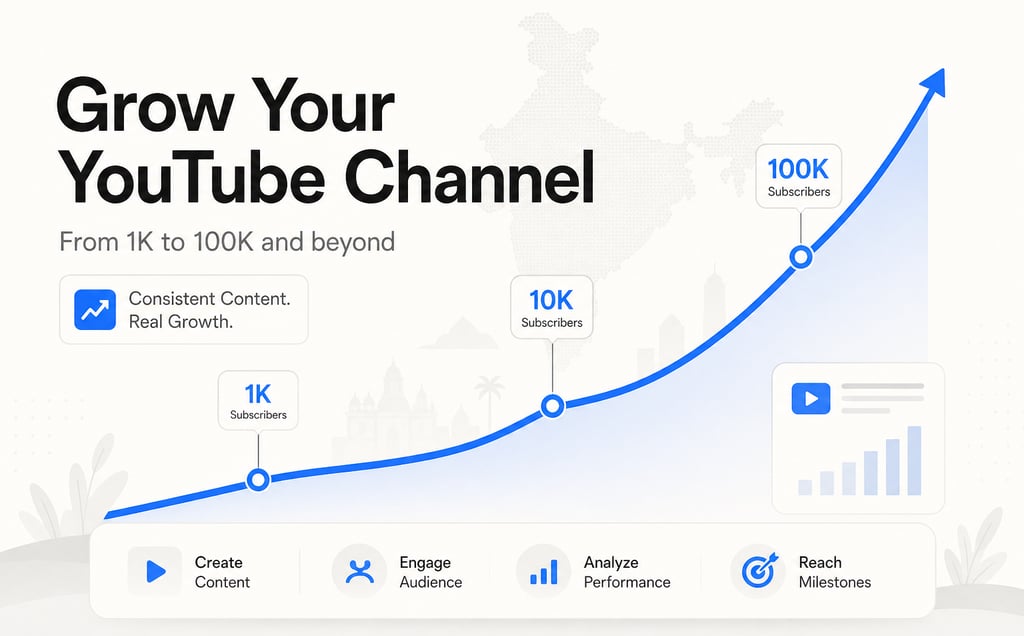
YouTube in India isn't a market anymore-it's the market. India has more YouTube users than any other country on earth. The opportunity is enormous. But the playbook that works for growing a channel globally doesn't work here, and creators who copy American YouTube advice tend to stall at exactly the same milestones.
Here's why: CPMs are lower (meaning you can't rely on ad revenue alone), regional languages dominate audience behavior, mobile-first viewers have different retention patterns, and the content that goes viral looks nothing like what trends globally. Growing a channel in India in 2026 requires a completely different strategy.
This is the playbook we've built from working with hundreds of Indian creators. It's organized by phase-where you are matters more than how much time you've spent. Phase 1 is about proving your niche works. Phase 2 is about doubling down on what's working. Phase 3 is about systematizing and diversifying income so you're not chained to ad revenue.
The Indian YouTube Landscape: Why Standard Growth Advice Often Fails Here
Most growth advice online is built for American audiences. That fails in India for several structural reasons.
Lower CPMs mean lower ad revenue. Indian CPMs (the cost advertisers pay per thousand views) are $0.25-$0.50, compared to $3-$8 in the US. A channel with 500K views in India makes $125-$250 in ad revenue. The same channel in the US makes $1,500-$4,000. This isn't a small difference; it's the difference between viable and unsustainable. It forces Indian creators toward diversified income: sponsorships, affiliate commissions, digital products, Patreon, brand partnerships. Relying solely on YouTube's Partner Program will starve your channel.
Regional languages are where the real audience is. English content gets visibility globally, but it's fighting against every other English creator on the platform. Hindi, Tamil, Telugu, Kannada, and Marathi content serves audiences that are massive and underserved. A Hindi video about personal finance or exam tips has way less competition than an English version of the same topic. The algorithm prioritizes watch time and engagement over language; if your regional language content keeps people watching, it gets pushed. Many creators see 2-3x faster growth switching to regional languages.
Mobile viewers have different behavior. 90%+ of YouTube views in India come from mobile. Viewers are watching during commutes, between other tasks, often on limited data. This means your hook needs to land in the first 5 seconds, your content should hit key points early (people drop off if the payoff takes 30 seconds), and your edits need to be tight. A 12-minute video for a desktop audience becomes a 7-minute video for mobile India.
What goes viral is emotionally resonant, not just novel. Indian audiences respond to content that solves a real problem, tells a relatable story, or makes them feel seen. "How I went from 0 to 100K followers" works. "The rise and fall of some random startup" doesn't. Videos that reference everyday struggles-missing the rent, failing an exam, being judged by family for career choices-perform disproportionately well. Relatability is the lever.
Because of these factors, creators who copy global YouTube channels tend to hit a ceiling at 5-10K subscribers and have no idea why. They're optimizing for the wrong metrics and building content for the wrong audience.
Phase 1: Establishment (0-1,000 Subscribers) - The Niche and Consistency Phase
Your goal in Phase 1 is simple: prove that your niche works and build a habit of publishing.
Pick a niche that's underserved but searchable. Avoid the massive trap that catches most Indian creators: starting with a generic niche (cooking, gaming, vlogging, motivation) and hoping differentiation happens over time. It doesn't. You'll spend 6 months making generic content that looks like 500 other channels.
High-opportunity niches for Indian creators right now:
Personal finance in regional languages - How to invest 10K, tax planning for freelancers, mutual funds explained in Hindi. Most content is in English; regional audiences are desperate for this.
Career guidance for students and graduates - Resume writing, interview prep, job search strategy for tier-2 cities. Huge search volume, low competition.
Tier-2/tier-3 city lifestyle - What it's like living, working, and building in smaller cities. Massive untapped audience.
Vernacular tech reviews - Phone reviews, laptop comparisons, software explainers in Hindi, Telugu, Tamil. Usually dominated by English channels.
Exam preparation (JEE, NEET, SSC, UPSC) - Strategy tips, subject walkthroughs, motivation. Competitive but high-volume searches.
The pattern: pick something people in India are actively searching for, that isn't already owned by one giant creator, and that you can talk about for 50 videos without running out of ideas.
Consistency beats frequency. This is the most important rule in Phase 1. One video every Friday, without exception, beats three videos one week and nothing for two months. The algorithm rewards channels that upload on a predictable schedule; it punishes gaps. Your first 50 videos are about proving you'll stick around. Pick a frequency you can sustain forever-usually one video per week-and hit that rhythm.
Hook them in the first 30 seconds. Indian audiences are impatient. You need to state the problem and promise the solution in the first 30 seconds, or they're gone. Structure: "In this video I'm going to show you how to X in 7 minutes" or "90% of people do this wrong-here's the right way."
Respond to every comment. For the first 6 months, treat comment replies like customer service. Respond to every comment personally. This serves two functions: the algorithm counts engagement, and you signal that you care. This habit also generates ideas for future videos from your audience directly.
Study your best performer. After 10 videos, identify which one got the most watch time. Don't just note it-deconstruct it. What was the hook? How was it structured? What visuals did you use? Now make 5 more videos with that same structure. Most creators get this backward; they make one successful video then try something completely different next. Ride the success until it plateaus.
By the end of Phase 1 (around video 30-40), you should have one video that's significantly outperforming the others, and a niche that makes sense. If nothing's breaking 1K views by video 40, your niche is either too narrow or not searchable. Pivot.
Phase 2: Momentum (1K-10K Subscribers) - Double Down and Collaborate
Phase 1 proved the concept. Phase 2 is about acceleration.
Double down on your best-performing format. You have pattern data now. The videos that work have something in common-a structure, a topic angle, a visual style. Make 10 more of those. Don't diversify yet. The algorithm is starting to recognize patterns in your content; lean into that signal.
Collaborations multiply reach. Find channels 30-50% larger than yours and propose collabs. A creator with 3K subscribers collabs with someone who has 5-8K. This isn't about equal reach; you want their audience to discover you. The collab gets their subscribers to your channel. Aim for one collab every 4-6 weeks in this phase.
Thumbnails start mattering. By 1K subscribers, thumbnail quality correlates directly with CTR (click-through rate). Use high contrast, readable text (5-6 words max), and an emotional face if you're on camera. Test variations and track which thumbnail gets the highest CTR for similar videos. Slight differences (emoji vs. no emoji, pose variation, color change) can mean 20-30% higher CTR.
Start building a community. Launch a Discord, a WhatsApp group, or a Telegram channel. In Phase 1 you built habit; in Phase 2 you build loyalty. The goal isn't huge numbers-50-100 active community members who feel like insiders. They become your testing ground for new ideas and your first wave of shares.
Publish timing matters now. Upload consistently at the same time. 8-10 AM IST or 7-9 PM IST performs best for Indian audiences. YouTube's algorithm prioritizes early engagement; if your subscribers watch within the first 4 hours, the algorithm pushes the video wider. Consistency in publish time trains your audience to expect you.
Diversify your platform presence. YouTube Shorts and Instagram Reels are your discovery tools, not your monetization. Repurpose a 30-60 second clip from each long-form video as a Short and a Reel. Use it as the hook: "I broke down the 5 most common interview mistakes-watch the full breakdown on my YouTube channel." Your Shorts are funnel, not product. The money is in long-form video.
By the end of Phase 2 (around 8-10K subscribers), your growth should feel exponential. If you're still grinding out single-digit growth per month, your content isn't resonating or your collaborations aren't effective. Audit and adjust.
Phase 3: Scale (10K+ Subscribers) - Systematize and Diversify Income
At 10K, you have proof of concept. Phase 3 is about scaling sustainably and making money.
Systematize content production. By now you've proven what works. Document your process: topic selection, scripting, filming, editing, upload. Bring in help where it's expensive in time (editing, thumbnail design, comment management). You can't scale by working harder; you scale by working smarter.
Diversify income immediately. Don't wait for higher CPMs or higher view counts. Start now:
Sponsorships and brand deals. Even at 10K subscribers, companies will sponsor videos if your audience is engaged and niche. Brands care about watch time and audience quality, not size.
Affiliate commissions. If you review products or recommend tools, use affiliate links. Amazon Associates pays 2-10%; specialized affiliate programs (hosting, software, courses) pay 20-40%.
Digital products. A course, template, or guide sold to your audience at $19-99 generates more revenue than 10,000 views. Start with 1 product and validate demand before scaling.
Community support. Patreon, YouTube memberships, or a Superchats plugin lets your most engaged viewers support you directly.
At 10K subscribers with decent engagement, $500-1,000/month from diversified income is realistic. At 50K, that's $2,000-5,000+.
Create a content calendar, not a chaotic upload schedule. Plan 4-8 weeks ahead. This gives you time to batch-record, edit without panic, and test variations. Spontaneous uploads stop working at this scale; you're competing with channels that have editorial calendars.
Double down on audience insights. Check YouTube Analytics weekly. Three metrics matter:
Traffic sources. If your growth is coming mostly from subscribers, your algorithm reach is low. If browse features (YouTube's recommendations and homepage) is your top source, congrats-the algorithm is pushing you. If search is your top source, optimize your titles and descriptions for the keywords you want.
Average view duration. If people are dropping off at the 3-minute mark consistently, your pacing is too slow or your hook didn't deliver on the promise. Re-edit for tighter pacing.
Click-through rate (CTR). Anything below 3% means your thumbnail or title isn't compelling. Test variations.
Plan your next major milestone. At 10K, start working toward 4,000 watch hours. Once you hit that, you're eligible for YouTube Partner Program monetization (if you haven't already). At 50K, plan for sponsorship partnerships and course launches. At 100K, consider sponsorship-first revenue (sponsorships usually outpace ad revenue at this scale).
Content Strategy for Indian Audiences: What Actually Gets Watched
The hook formula that works: relatable problem + promised outcome in 30 seconds. "Everyone fails their first interview. Here's why, and what actually works."
Structure matters more than production. Indian audiences don't care if your camera costs $200 or $2,000. They care if the content solves a problem or entertains them. A well-structured video shot on a phone outperforms a poorly structured video shot on cinema equipment.
Here's the structure that works:
Hook (first 30 seconds). State a problem or ask a question the audience cares about. "Most people spend 3 months job hunting. I got hired in 2 weeks-here's what I did differently."
Credibility (10-15 seconds). Why should they listen? "I've interviewed 200 people and placed 50 in their dream roles."
Promise (5-10 seconds). What will they get? "By the end of this video you'll have a resume template and know exactly how to position yourself."
Content (bulk of video). Deliver on the promise. No fluff, no rambling. Every sentence earns its place.
Call to action (last 10 seconds). Subscribe, join the community, visit the next video.
Emotional resonance beats novelty. A video about "how I failed my exam 5 times and still got into engineering" performs better than "the top 10 colleges in India." Vulnerability and relatability are the leverage.
Case studies and personal stories outperform generic advice. "How to negotiate salary" flops. "I negotiated 20% higher on my offer-here's the exact script I used" works. Specificity is more believable and more useful.
Titles matter more than you think. Your title is the last thing someone reads before deciding to click. It should have the keyword you want to rank for, tease the benefit, and feel genuine (not clickbait). "How I Got 5 Job Offers Without Referrals" beats "Job Interview Secrets Recruiters Don't Want You to Know."
The Analytics You Must Check Every Week
Don't wait for monthly reviews. Check these metrics every Sunday:
Views and watch time. How many people watched, and for how long total? Watch time is the algorithm's primary signal.
Click-through rate (CTR). What percentage of people who saw the thumbnail actually clicked? If your CTR is dropping week to week, your thumbnail strategy is off.
Average view duration. Where are people dropping off? If the average is 40% of your video length, people are losing interest. Check if there's a pacing issue or false promise in the hook.
Traffic sources. Is growth coming from subscribers, search, browse features, or external? Search and browse features mean the algorithm is pushing you. Subscribers-only growth means you're not reaching new people.
Audience retention graph. The analytics show a second-by-second retention graph. Where does it dip? Usually there's a visual pattern: if retention drops at 2 minutes, your pacing or hook follow-up is weak.
Most creators ignore analytics and wonder why they plateau. The data tells you exactly what's working and what isn't.
Cross-Platform Strategy: Using Shorts and Instagram to Accelerate Growth
YouTube Shorts and Instagram Reels are funnels, not destinations. They drive people to your long-form YouTube content where you make money.
Repurpose aggressively. Every long-form video should generate 3-5 Shorts/Reels. Take a 30-60 second clip that's self-contained, has a hook, and leaves the viewer wanting the full answer. Post the same Short on YouTube Shorts, Instagram Reels, and TikTok. It's the same content, three different feeds.
Hook them with incompleteness. The clip should tease the full answer but not deliver it. "The #1 mistake in job interviews-find out what it is and how to avoid it [link in bio]." The full breakdown lives on your YouTube channel.
Consistency applies here too. If you have 3 YouTube videos coming out per week, you should have at least 9 Shorts/Reels (3 per video, across platforms). This is low-effort once you batch-create-spend 30 minutes pulling clips from a long-form video.
Track which clips perform best. If one clip gets 50K views but the YouTube video it came from gets 5K, your funnel is leaky. The clip is interesting but you're not driving clicks. Test different CTAs and descriptions to improve conversion.
Shorts are your free discovery channel. Every view is a potential YouTube subscriber; every 1-2% of those views that convert to YouTube channel visits is growth.
Common Mistakes Indian Creators Make at Each Stage
Phase 1 mistakes:
Picking a niche because it's easy, not because it's searchable. "Vlogs" and "motivation" are too broad.
Uploading inconsistently. Posting 4 times one week and nothing for 3 weeks tanks momentum.
Not responding to comments. Early engagement is the only engagement you have; ignore it and you signal that you don't care.
Comparing growth rate to bigger channels. A 5K subscriber channel growing 200 subs/month is doing better than an 800K channel growing 3K/month. Growth rate matters more than absolute numbers.
Phase 2 mistakes:
Diversifying too early. You found what works; now do more of that, not a totally different thing.
Collaborating with channels of wildly different sizes. A 500 subscriber channel collabs with a 100K channel and gets zero benefit because their audience has nothing in common.
Ignoring thumbnail performance. Thumbnails at 1K+ are as important as content. Test variations relentlessly.
Burning out and disappearing. Many creators push hard in Phase 2, achieve 5-8K subscribers, then quit because they didn't hit 100K yet. You're close; that's when you double down.
Phase 3 mistakes:
Chasing sponsorships before proving consistent watch time. Brands want reliability; prove 4-8 weeks of consistent 5-10K monthly views before approaching sponsors.
Launching a course with no audience. Your audience is your customer base. Course demand doesn't appear out of nowhere; it builds from people asking you for help for months. Only then should you build the course.
Outsourcing without systems. Hiring an editor is great; having no process for feedback is chaos. Systematize first, then delegate.
Assuming higher subscriber count = higher income. A 20K subscriber channel with high engagement and diversified income often makes more than a 100K subscriber channel relying on ads alone.
Frequently Asked Questions
How long does it take to reach 1,000 subscribers on YouTube in India?
It typically takes 3-6 months if you're consistent with content, niche-focused, and responding to every comment. The real variable isn't time-it's whether your content resonates with Indian audiences. Many creators spend 12+ months because they're chasing generic niches. Pick something people in India are actually searching for, and the timeline compresses. Here's our detailed guide to reaching 1K faster.
Should I upload in English or regional languages?
Both. Use Hindi or your regional language for the video content (it gets Indian audiences), then write the title and description in English with SEO keywords. YouTube's algorithm picks up on language patterns; English titles + descriptions help the algorithm understand your content is searchable. This dual approach captures both regional viewers and the broader English-speaking Indian audience. Many creators who doubled down on Hindi saw faster growth in tier-2 and tier-3 cities.
How often should I post to grow faster?
Consistency matters infinitely more than frequency. Posting once a week, every week, beats posting 3 times a week for 2 months then disappearing. The algorithm punishes gaps in your upload schedule; missing even one week breaks momentum. Start with one video per week and hold that rhythm. Once your audience is locked in, you can experiment with frequency without losing traction. The algorithm favors consistent creators over sporadic ones.
What's the best time to upload in India?
Upload between 8-10 AM IST (morning commuters) or 7-9 PM IST (evening viewers winding down). YouTube pushes new uploads to subscribers first, so timing matters less than consistency. However, these two windows see the highest engagement rates in India. Test both windows over a month and stick with whichever gets you better watch time in the first 4 hours after upload.
Is buying subscribers or using growth services worth it?
No. Bought subscribers tank your engagement metrics (watch time, average view duration, click-through rate), which signals to YouTube's algorithm that your content isn't resonating. The algorithm then suppresses your videos from recommendations. Real growth from real people is slower but exponential; fake growth flatlines and burns. Work with a YouTube growth partner who focuses on organic strategy instead.
Try Ytverse
If you're serious about growing in 2026, you need strategy that's actually tuned to Indian audiences, not generic YouTube advice. Ytverse helps Indian creators handle the parts that slow you down-niche research, growth strategy, analytics review, collab matching. We've worked with creators at every stage from 0 to 100K+, and the playbook we've shared here is what actually works here. Whether you're just starting or stuck at a particular milestone, the right guidance at the right time makes the difference between 6-month plateaus and consistent exponential growth. Check it out and let's talk about where your channel is now.