
How the YouTube Algorithm Works in 2026 & How to Use It for Growth
Confused about the algorithm? Understand the 4 core ranking factors YouTube actually uses-and how to optimize for them.
Utkarsh Agrawal
5/27/202610 min read
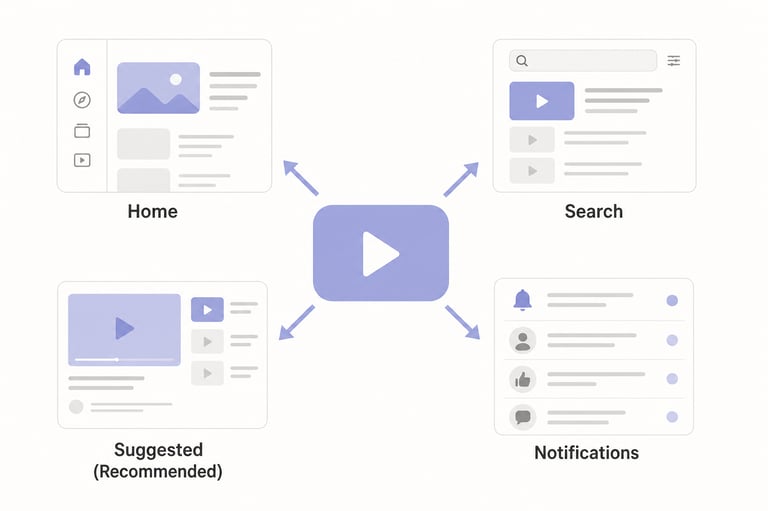
Most creators blame the algorithm when their videos don't grow. The truth: you probably just don't understand how it works. And that's fixable.
YouTube's algorithm doesn't punish channels or pick favorites. It's a matching engine - it tries to pair each viewer with videos they'll click and watch. When you understand what the algorithm is actually optimizing for, you can work with it instead of against it.
This guide breaks down how the 2026 algorithm distributes your videos, which signals matter most, and exactly what Indian creators need to hit to get recommended. None of this is guesswork - it's grounded in how the platform actually works.
What the YouTube algorithm actually does (and doesn't do)
The algorithm has exactly two jobs:
Surface videos viewers want to watch
Keep viewers on YouTube longer
That's it. It's not about fairness, supporting small channels, or promoting "quality" in some moral sense. It's about watch time - yours and everyone else's.
Here's what it doesn't do: it doesn't penalize you for being new, small, or uploading inconsistently (those just make growth slower). It doesn't suppress "controversial" content. It doesn't favor YouTube Partners over regular creators. It doesn't suppress competitor channels. And it doesn't have an "algorithm reset" - a fresh start when you change niches. It just stops recommending you to people interested in your old niche and starts testing you with people interested in your new one.
The algorithm is relentless about one thing: it tests videos with small audiences first. If viewers click and watch, you get wider distribution. If they don't, you're done - the algorithm has other videos to push.
The 4 places where the algorithm distributes your videos
Not all views are equal. Each distribution surface - Homepage, Search, Suggested, Notifications - has its own algorithm and serves different viewer intent.
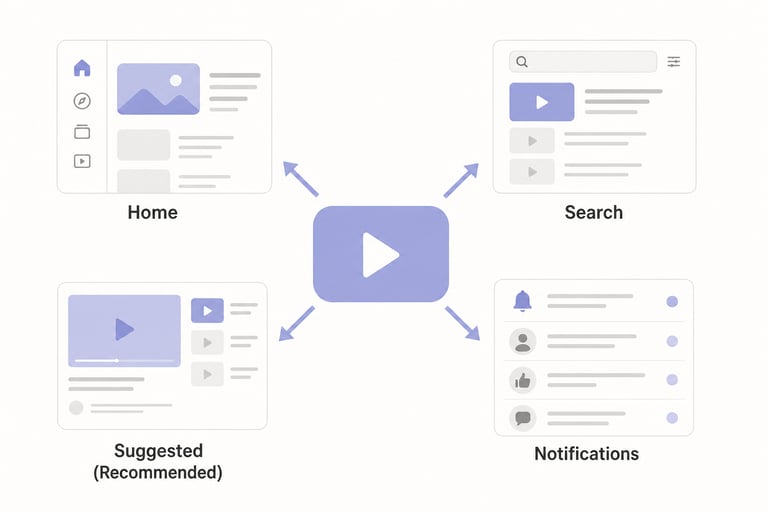
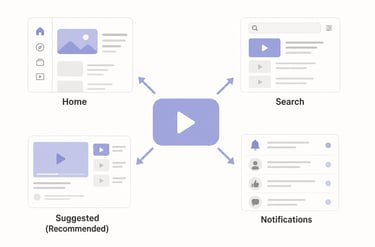
Homepage - The feed viewers see when they land on youtube.com or open the app. The algorithm ranks videos it thinks this specific person will click. It pulls from your subscription feed, videos you might like based on history, trending videos. This is where most new channels get stuck - you need a subscriber base and watch history relevance to show up here consistently.
Search - When a viewer types a query. YouTube ranks videos by relevance and engagement signals. New channels can rank here faster than on Homepage, especially if your title and description match the search query well. Search traffic is "intent-driven" - viewers are actively looking for what you made. Higher conversion from search than from browse surfaces.
Suggested (Recommended) - The "Up next" queue when someone's watching a video. Appears in the sidebar on desktop and at the end of videos on mobile. YouTube recommends videos that keep the viewer in a "session" - they keep watching. This is where a lot of growth happens because it benefits from the audience already watching related content.
Notifications - The bell icon in the subscriber list. YouTube notifies subscribers about new uploads, but it doesn't notify everyone. Regular uploaders get preference - the algorithm notifies a larger percentage of your subscribers if you upload consistently. New channels and sporadic uploaders get fewer notifications.
Most creators fixate on Homepage. In reality, Suggested and Search are where consistent growth happens, especially early. Notifications matter for retention once you have an audience.
The signals that move the algorithm (in order of importance)
YouTube weights ranking signals differently depending on the surface. On Homepage and Suggested, these signals matter most:
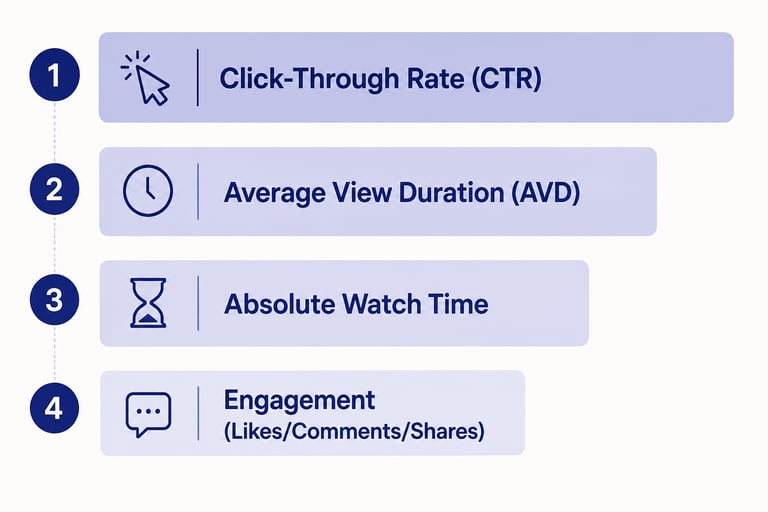
Click-Through Rate (CTR) - The percentage of impressions that turn into clicks. If your video thumbnail is shown 100 times and 6 people click it, your CTR is 6%. This is the first signal the algorithm checks. It tells YouTube: is the thumbnail and title compelling enough that viewers want to watch this?
Average View Duration (AVD) - How long viewers watch on average, as a percentage of your video's length. A 10-minute video watched for 5 minutes = 50% AVD. A 10-minute video watched for 2 minutes = 20% AVD. AVD tells YouTube: once the viewer clicked, did they find what they expected? High AVD signals quality and relevance.
Absolute Watch Time - Total minutes watched across all viewers. A 5-minute video with 1,000 viewers = 5,000 minutes. A 20-minute video with 200 viewers = 4,000 minutes. YouTube cares about this because it measures how much engagement the video creates on the platform, not just the channel.
Engagement Velocity - Likes, comments, and shares relative to views. Higher engagement in the first hour signals to the algorithm that the video is resonating. Comments specifically trigger the algorithm's attention - they indicate the video sparked enough interest for someone to type a response. Engagement also matters because engaged viewers tend to watch more videos, which keeps them on YouTube longer.
The ranking is real: if your CTR is too low (under 2%), YouTube stops pushing the video regardless of how good your AVD is. Even perfect watch time can't save a video people don't want to click.
CTR: How to make the algorithm fall in love with your thumbnail
A 4-10% CTR is solid. Below 2%, the algorithm essentially abandons the video. This is why thumbnails matter more than most creators think - they're the first signal.
Good CTR signals come from:
High contrast - Your thumbnail should pop on a dark mobile screen. A bold color or bright background is non-negotiable. If it looks dull at thumbnail size (which is tiny), it'll get low CTR.
A face - Faces grab attention faster than anything. If you're on camera, make sure your face is in the thumbnail. Thumbnails with faces consistently beat ones without.
Text overlay - Contrast-colored text that answers the question in the title. "THIS WORKS?" beats "How to grow your channel." Bold, short, readable at small size.
Curiosity gap - The title and thumbnail should raise a question the video answers. Not clickbait (we'll cover that below), but genuine intrigue.
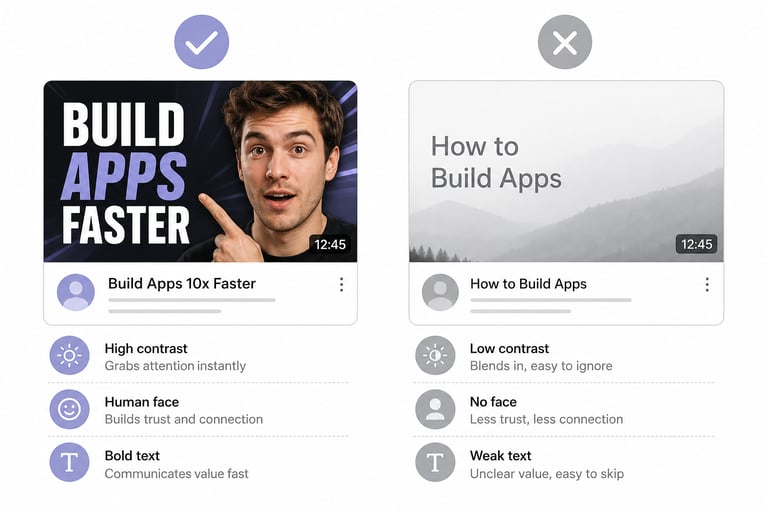
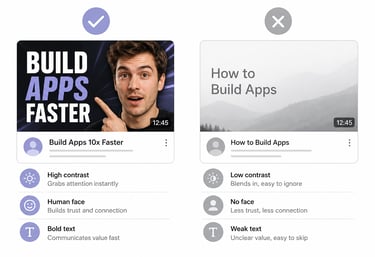
Most creators underestimate thumbnail power. A small improvement in CTR compounds: 4% CTR instead of 3% means 33% more clicks on the same impressions, which gives the algorithm a stronger signal, which means more impressions, which means exponentially more views.
The algorithm tests every video with a small audience first - usually 50-200 impressions. Your CTR on those first impressions directly determines your reach ceiling. A 6% CTR in the first hour can expand distribution to 10,000+ impressions by hour 6. A 2% CTR locks you in the low thousands.
Watch time and retention: The numbers you need to hit
CTR gets the algorithm's attention. Watch time keeps it.
Aim for 50%+ average view duration. This tells YouTube the video is relevant and engaging. Videos that consistently hit 50% AVD get wider distribution; videos under 30% get suppressed.
How to improve retention:
Front-load value - Deliver the answer in the first 30 seconds. Don't make viewers wait for intros. Hook them immediately. This is especially important because YouTube looks at the first 30 seconds to decide whether to show your video to more people.
Edit ruthlessly - Remove dead space, ums, filler. Pacing matters more than length. A tight 8-minute video beats a rambling 12-minute one.
Pattern interrupts - Cut to a different angle, B-roll, or graphic every 5-10 seconds. It keeps viewers visually engaged and reduces the bounce rate.
End screens and cards - Point viewers to your next video while they're still watching. This increases "session watch time" - the total time a viewer stays on YouTube after finishing your video. The algorithm rewards this heavily.
YouTube's algorithm cares about "session watch time" - not just your video's watch time, but how much total time a viewer spends on YouTube after they watch yours. A viewer who finishes your 10-minute video and then watches someone else's 15-minute video is worth more to the algorithm than a viewer who just watches yours. Link to related content, ask them to watch your next video, and optimize for binge-ability.
Upload consistency and the algorithm relationship
The algorithm has a memory. Regular uploaders build it.
When you upload consistently:
Subscribers get notifications - The algorithm notifies a higher percentage of your subscribers when you upload on a schedule. Sporadic uploaders get fewer notifications because the algorithm doesn't expect uploads.
Recommendation confidence increases - The algorithm recommends you to more people if it knows you consistently deliver. Consistency signals reliability.
Higher impression test size - New videos from regular channels get tested with larger initial audiences. New channels and irregular uploaders get tinier tests.
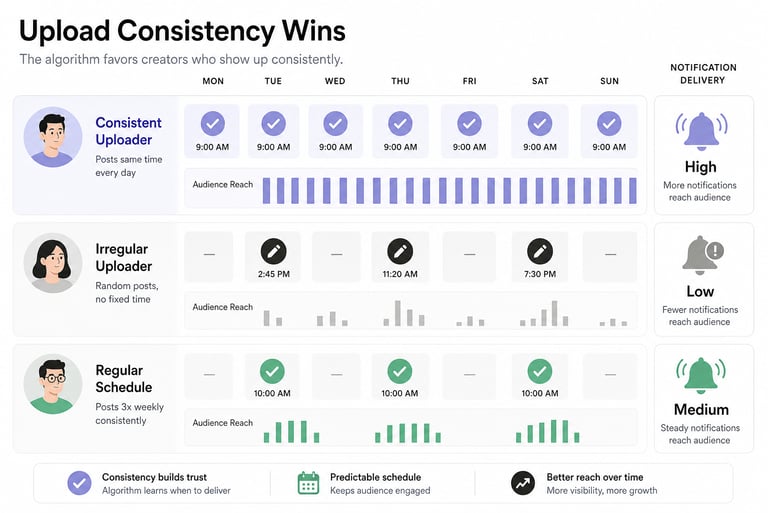
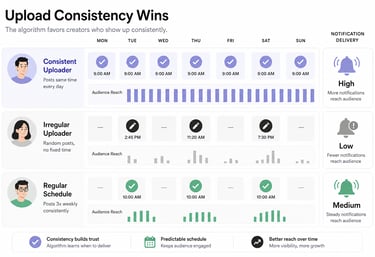
You don't need to post daily. Three to seven uploads per week is the sweet spot for most content types. The key is predictability - post at the same time on the same days. If you post on Monday, Wednesday, and Friday at 10 AM, the algorithm learns this and prioritizes your channel during those times.
For Indian creators especially, this matters because upload consistency is one of the few signals you fully control that doesn't depend on audience size or watch history data.
The algorithm for Hindi and regional language creators
Here's the good news: regional language content has less competition in the algorithm's recommendation pools.
YouTube maintains separate recommendation systems for each language. When a viewer who watches content primarily in Hindi loads their feed, YouTube pulls from a specialized Hindi recommendation pool. The same for Tamil, Telugu, Kannada, and Malayalam.
Because there are fewer Hindi channels than English channels, there are fewer videos competing for the same recommendation slots. Quality Hindi content gets distributed to a larger percentage of the Hindi-speaking audience than equivalent English content would reach in the English-speaking pool.
The algorithm still applies the same rules: CTR matters, watch time matters, consistency matters. But the pool is smaller, so distribution is faster. A creator with 50,000 subscribers making quality Hindi content can reach their audience faster than an English creator at the same subscriber count.
This advantage compounds if you focus on a niche within regional language (e.g., finance tips in Hindi, or productivity hacks in Tamil). The algorithm has even less competition to work with.
If you're bilingual, posting both English and Hindi content on the same channel can dilute performance - the algorithm gets confused about which pool to recommend you to. Most successful regional creators build separate channels: one for English, one for regional language.
What NOT to do: algorithm killers
Clickbait that lies - High CTR with low watch time is a penalty. Viewers click because the thumbnail promised something your video doesn't deliver. They exit fast, watch time crashes, and the algorithm sees the mismatch. Your next video gets a smaller test audience. Curiosity gap (raising an honest question) beats deception every time.
Misleading titles and descriptions - Same problem as clickbait. A title that promises "revealed the YouTube algorithm secret" better deliver substantive insights, not vague platitudes.
Artificially padded watch time - Asking viewers to skip ahead, pausing the video, or adding filler doesn't fool the algorithm. YouTube measures real watch time, not play-button duration.
Disabling comments - No comments means no engagement velocity signal. Even negative comments are better than no comments because they indicate the video sparked something.
Repeating or AI-generated content - The 2026 algorithm heavily penalizes repetitive content and AI-generated material without original commentary or value-add. If your video is just a compilation of publicly available information with no original perspective, the algorithm suppresses it. Original, human-authored content gets distribution preference.
Inconsistent niche jumping - Posting about gaming one week and cooking the next week confuses the algorithm. It doesn't know which audience to recommend you to. Pick a niche, master it, then expand thoughtfully.
Frequently Asked Questions
What's the difference between impressions and views on YouTube?
Impressions are when YouTube shows your video thumbnail to a viewer. A view counts when someone watches your video for at least 30 seconds. The algorithm uses impressions to test new videos with small audiences first - high CTR on those initial impressions means wider rollout. You can see both metrics in YouTube Analytics.
How much does YouTube Shorts affect my long-form video growth?
Shorts and long-form videos have completely separate recommendation algorithms. Publishing a Short doesn't automatically promote your long-form content. Each format is optimized for different viewing patterns - Shorts for discovery and session time, long-form for deep engagement. Growth in one format doesn't cross over, so focus on what your audience actually watches.
Do I really need to post on a consistent schedule?
Upload consistency signals reliability to the algorithm. Regular uploaders get preference in notification delivery - your subscribers see the notification more reliably than casual posters. You don't need to post every day, but posting at predictable times and frequencies (3-7 times per week for most creators) gives the algorithm confidence to notify your audience.
What happens if my video gets low watch time immediately after upload?
YouTube starts with a small audience test. If your average view duration is under 30%, the algorithm reduces distribution. But you still have a window: the first few hours matter. Reply to comments quickly, pin a comment asking viewers to finish the video, or update the title/description if the hook isn't landing. Early engagement signals can improve distribution before the algorithm moves on.
Is regional language content easier to grow on YouTube?
Yes - there's less competition in Hindi, Tamil, Telugu, Kannada, and Malayalam recommendation pools. The algorithm has to fill those feeds with something, so quality regional content gets distributed to more people within that language pool. That said, quality and consistency still matter. Regional language content competes against other regional content, not against English
How ytverse.in helps Indian creators beat the algorithm
The algorithm is mechanical, but it's not forgiving. You need to optimize thumbnails, track retention, and maintain consistency - all while creating content. Most creators flying solo miss signals until weeks later.
ytverse.in helps Indian YouTube creators do this faster. We analyze algorithm trends specific to Indian creators, help you optimize your channel for 4,000 watch hours and 1,000 subscribers, and guide you through the exact growth strategies that work on the platform right now.
You can also dive deeper into the 2026 algorithm and learn how to grow your YouTube channel in India with data-driven tactics.
The algorithm isn't random. Learn the rules, apply them consistently, and you'll outpace creators who rely on luck.
Ready to grow? Start with ytverse.in and get a growth strategy tailored to your channel.