
How to Increase Watch Time on YouTube: 7 Proven Tactics
Actionable strategies to hit YouTube's 4000 watch hours requirement faster. Learn the fastest methods, realistic timelines, and common mistakes to avoid.
Utkarsh Agrawal
5/24/20269 min read
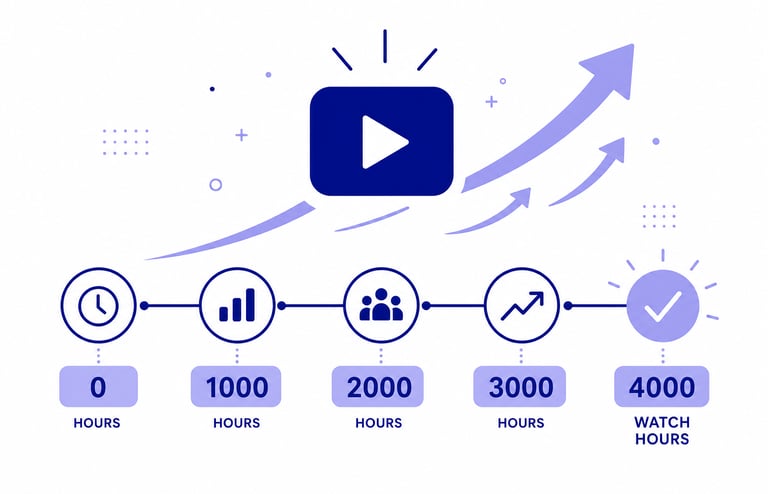
You've been grinding on YouTube for months. Your content is solid. Your community is engaged. But you're stuck watching the watch hours counter climb... slowly. You need 4000 valid public watch hours to unlock YouTube Partner Program monetization, and right now you're nowhere close.
The frustration is real for Indian creators especially-YouTube's algorithm doesn't favor all regions equally, which means it takes longer to accumulate that critical 4000-hour threshold. But here's the truth: you don't have to wait 12-18 months. There's a playbook. Some creators hit 4000 hours in 4-6 months. Others take 14 months. The difference isn't luck-it's strategy.
This guide breaks down exactly how watch hours work, which methods actually build them fast, and the mistakes that are silently eating into your progress.
What Counts as Valid Watch Time
Before you optimize, you need to know what actually counts. YouTube is specific about this.
Valid watch hours come from:
Long-form videos (videos at least 1 minute long)
Public videos only (unlisted and private don't count)
Genuine viewer engagement (watch time from actual people, not bots)
Views from the last 12 months (rolling window-old content still counts if it's getting views now)
What doesn't count:
YouTube Shorts (ever, regardless of view count)
Your own views (rewatching your content doesn't build your hours)
Embedded videos from external websites
Videos still in processing
Watch time from deleted videos (gone forever once you delete)
The "rolling 12-month" part is crucial. If you uploaded a video 6 months ago and it gets 50 views today, those hours count right now. You don't need fresh content only-you can lean on older videos still gaining traction.
The Math: How Far Are You Really?
Let's be honest about where most creators stand. If you're aiming for 4000 hours and tracking closely, you probably have between 100 and 1500 hours already.
Here's what the gap looks like in terms of actual viewers:
A viewer watching one 10-minute video = 10 minutes of your watch hours
A viewer watching a 5-video playlist = 50 minutes of watch hours
A 2-hour live stream with 100 concurrent viewers = 200 watch hours in one sitting
The scaling math changes depending on method. A single viral video with 100K views at 70% average retention (7 minutes watched per viewer) = 12,000 watch hours. But viral is unreliable. Consistency is what compounds.
For an average Indian creator publishing 2x weekly without live streaming: you're looking at 8-14 months to hit 4000 hours. With live streaming and playlist optimization mixed in: 4-6 months. The difference is method, not mystique.
Method 1: Live Streaming (Fastest)
This is the watch-hours cheat code. A single 3-hour stream with 60+ concurrent viewers generates 180+ watch hours immediately. That's roughly 1.5% of your goal in one session.
Why it works so fast:
Every concurrent viewer counts the full duration (60 viewers × 3 hours = 180 watch hours)
It's predictable and repeatable (unlike hoping for viral moments)
YouTube's algorithm favors live content, so your stream will get recommended to your subscribers
Live chat interaction keeps viewers watching longer
The real numbers: if you stream twice a week at 3 hours each with an average of 60 concurrent viewers, you're adding ~720 watch hours per month just from streams. Add consistent long-form uploads on top, and you compress the timeline dramatically.
How to make live streams work:
Schedule them consistently (same day, same time each week so viewers expect you)
Promote in advance on your community tab and social media
Go live with a purpose-don't just sit there. Have games, Q&As, behind-the-scenes content, or real tutorials
Interact heavily with chat (this keeps retention high and signals engagement to YouTube)
Repurpose the stream into short clips and full-video uploads afterward for secondary watch hours
Starting small: if you only have 10 concurrent viewers on your first stream, you still get 30 watch hours. 20 viewers = 60 hours. Building an audience for streams takes time, but the ROI is massive once you have even modest concurrent viewer counts.
Method 2: Long-Form Video Strategy (Most Sustainable)
Live streaming is fastest, but long-form videos are the foundation. Most creators don't have the schedule for twice-weekly streams, so you need a solid upload system.
The retention math everyone gets wrong: a 30-minute video with 20% average retention (viewers watch 6 minutes on average) generates 6 minutes of watch time per viewer. But a 10-minute video with 80% average retention (viewers watch 8 minutes) generates 8 minutes per viewer. The shorter video wins despite fewer total minutes available.
For Indian creators aiming for watch hours fast, this means:
Target 8-15 minute videos, not 25-minute or longer
Hook the viewer in the first 30 seconds (show them why this matters to them)
Use pattern interrupts every 2-3 minutes (cut to a different camera angle, show B-roll, add graphics, change your position)
End with a strong reason to keep watching your channel (preview your next video, direct them to your most popular video, or ask a question)
Upload frequency matters. One 10-minute video per week gives you a baseline, but two videos per week creates compounding momentum. YouTube's algorithm treats consistent, frequent uploads as a signal of an active channel. You want to be in the recommendation algorithm as often as possible.
Real example: 50 videos at 10 minutes each with 80% retention = 400 minutes (6.7 hours) of watch time per 1000 views. If you average 2000 views per video across 50 videos = 100,000 total views = 667 watch hours from long-form alone. Add in live streams, playlists, and compounding, and you're at 4000 in under a year.
Method 3: Playlist Architecture (Compounding Effect)
Playlists are underrated. When a viewer finishes one video in a playlist, YouTube auto-plays the next one. That single viewer can rack up 30-60 minutes of watch time without lifting a finger.
Here's the leverage:
Create 5-8 themed playlists around your main topics (if you're a gaming channel: "Best Plays," "Game Strategy," "Fails & Funny Moments")
Put your best-retention videos in each playlist
Link to playlists in your video descriptions and community tab
Make playlists discoverable in your channel layout
The compounding effect: a viewer who watches one video might auto-play through 3-4 more videos in a playlist. That's 4x the watch hours from a single click-through. Over months, playlist auto-play is responsible for 15-25% of watch hours for channels that structure them well.
Pro move: update playlists monthly. Remove videos with low retention, add your newest strong performers. YouTube's algorithm favors playlists that are actively maintained and deliver consistent quality.
Method 4: Repurposing Old Content (Free Hours)
You've already made dozens (or hundreds) of videos. Some of them are still getting views. That's free watch-hour potential sitting on your channel.
Repurposing tactics:
Re-upload strong older videos with a refreshed thumbnail and title (YouTube treats this as a new upload if you haven't published it before)
Create "best of" compilations from your top 10 most-watched videos-viewers often don't see older content, so a compilation feels new to them
Update and re-title evergreen content. A "2025 YouTube Strategy" video can be retitled "2026 YouTube Strategy" with a 30-second intro update, and it'll be treated as fresh by the algorithm
Unlisted → Listed strategy: if you have unlisted videos with good retention, make them public. They may have views from being shared privately, and now those hours count
Important: don't delete old videos hoping to re-upload. Deleted videos take their hours with them. Unlisting preserves the watch time while keeping your channel clean.
How Long Will It Actually Take?
Let's be realistic about timelines for Indian creators.
Without live streaming, publishing 1x weekly (52 videos/year):
8-14 months to hit 4000 hours
Assumes 3-5K average views per video, 7-minute average retention
Realistic for new creators building an audience
With live streaming (2x/month, 3-hour streams, 60+ viewers):
6-10 months to hit 4000 hours
Combines 2x weekly uploads + live stream strategy
Requires building an audience for consistent stream viewership
With aggressive strategy (2x weekly uploads + 2x weekly streams + playlist optimization):
4-6 months to hit 4000 hours
Most realistic for creators already at 500+ hours with engaged audiences
Requires serious time commitment (10+ hours/week of content production)
The variables that compress your timeline:
Video quality (higher production = higher retention = fewer videos needed for same watch hours)
Niche appeal (smaller, dedicated audiences watch longer than broad, casual audiences)
Existing audience (if you have 5K subscribers, your first video gets more traction than if you have 50)
Consistency (uploading 2x weekly for 8 months beats uploading 3x weekly for 2 months then stopping)
The variable that doesn't matter as much as you think: subscriber count. A 10K subscriber channel can have lower watch hours than a 1K subscriber channel if the 10K channel has lower retention. Engagement beats size.
Mistakes That Are Wasting Your Watch Hours
You might be doing everything "right" and still losing hours to preventable mistakes.
Mistake 1: Deleting videos you want to revise. Once deleted, those hours are gone forever. If a video isn't performing, unlisted it first, refresh it with a new thumbnail and description, then make it public again as a "new" upload. Same video, preserved hours.
Mistake 2: Focusing on Shorts instead of long-form. Shorts are growth machines-they're great for subscribers-but they don't count toward watch hours. Spend 60% of your effort on long-form, 40% on Shorts. Not the other way around.
Mistake 3: Ignoring the first 30 seconds. If your video loses 30% of viewers in the first 30 seconds, you're bleeding potential hours. Test different hooks (question, bold statement, curiosity gap) and keep what works. This single variable can double your average retention.
Mistake 4: Making videos too long without justification. A 25-minute video with 4-minute average retention generates less watch time than a 10-minute video with 8-minute average retention. Length only works if retention follows.
Mistake 5: Not using playlists. If you have 30+ videos and no organized playlists, you're leaving 15-25% of potential watch hours on the table.
Mistake 6: Setting videos to unlisted while they're getting views. Watch hours only count from public videos. If you've unlisted a video that was still earning views, make it public again immediately (or accept those hours are paused).
Mistake 7: Ignoring your "middle content." Most creators obsess over their top 5 videos and neglect the rest. Your 6th-20th best-performing videos are often more scalable-they're usually just missing small tweaks (thumbnail, title, tags) to get 2-3x more views.
Next Steps: Implement Your Strategy
You now have the playbook. The question is execution. Start with your strongest method first based on your current situation:
If you have an engaged audience (500+ subs): start with live streaming. It's the fastest path and your existing subscribers will help you hit concurrent viewer targets faster.
If you're building from small (under 500 subs): start with 2x weekly long-form uploads and aggressive playlist architecture. Build the foundation first, then add streams once you have audience momentum.
If you have dozens of videos already: start with repurposing and playlist optimization. This is free watch hours with no additional production work.
The creators who hit 4000 hours in 4-5 months aren't smarter than you. They're not luckier. They're combining all four methods at once and measuring what works. You can do the same.
Check out YT Verse's watch hours guide for deeper dives into each method, or explore the complete YouTube growth strategy for Indian creators. If you want to understand how YouTube's algorithm prioritizes content, our algorithm breakdown for 2026 covers the latest ranking factors.
Frequently Asked Questions
Do YouTube Shorts count toward the 4000 watch hours requirement?
No, Shorts views do NOT count toward your watch hours. The 4000 hours requirement applies only to valid public watch time on long-form videos. You need to focus on videos at least 1 minute long to build watch hours. Shorts are great for growth and channel authority, but they won't move the needle on watch hours.
Can I get watch hours from deleted videos?
No. Once you delete a video, any watch hours it accumulated no longer count toward your total. This is why archiving old content (keeping it unlisted instead of deleting) is a smart strategy-you preserve those hours while keeping your channel clean. If you're not sure about a video, unlisting is safer than deleting.
What's the fastest way to hit 4000 watch hours?
Live streaming is the fastest method. A single 3-hour stream with 60+ concurrent viewers generates 180+ watch hours immediately. Combined with long-form video uploads and playlist architecture, live streams can compress your timeline to 4-6 months instead of 12-14. Learn more in our complete watch hours guide.
How much watch time do I lose if my video retention drops?
Retention doesn't directly delete watch hours you've earned, but poor retention kills future watch hours. A viewer who clicks away after 10 seconds contributes 10 seconds of watch time. A 30-minute video with 20% average retention generates much less total watch time than a 10-minute video with 80% retention. Focus on hooks in the first 30 seconds and pattern interrupts every 2-3 minutes.
Is there a faster way than waiting 8-14 months?
Yes-if you're willing to combine multiple methods. Live streaming + consistent 2x weekly uploads + playlist optimization can cut that timeline to 4-6 months. The key is intensity: more streams, more videos, better retention. But there's no shortcut to 4000 valid public hours. Engagement pods and watch-hour buying are against YouTube's terms and risk termination
Try YT Verse
YT Verse helps Indian creators hit monetization milestones faster. Beyond watch hours, we offer strategies to hit 1000 subscribers (often the harder barrier for new creators), optimize channel setup for algorithmic growth, and analyze what's working in your niche. Our guides are built specifically for Indian creators navigating YouTube's unique growth challenges in this region.
Head to ytverse.in to explore the full creator toolkit.