
Why Your YouTube Channel Isn't Monetized Yet & How to Fix It
Your channel meets all YouTube requirements but still not monetized? Here's exactly why-and the 5-step to get approved.
Utkarsh Agrawal
5/24/20268 min read
You've been uploading consistently. You hit 1,000 subscribers. You waited for months to cross 4,000 watch hours. You applied - and then nothing. Either it got rejected, or you're still grinding toward that finish line wondering when it'll actually happen.
You're not alone. Thousands of Indian creators go through this exact loop every month.
Here's the truth: most YouTube monetization problems have very specific, fixable causes. This guide breaks down exactly what YouTube looks for, why channels get rejected, and the fastest paths to getting approved - whether you're starting from scratch or trying again after a rejection.
What Is the YouTube Partner Program (YPP)?
The YouTube Partner Program is YouTube's official monetization system. When you're accepted, YouTube serves ads on your videos and shares that revenue with you. You also unlock:
Channel memberships - monthly subscriptions from your audience
Super Chat and Super Stickers - live stream earnings
YouTube Premium revenue - a cut of Premium subscribers' fees when they watch your content
Merchandise shelf - direct product sales from your channel page
YPP is the gateway to everything. Without it, you're leaving all of this money on the table.
The Complete YouTube Monetization Checklist (2026)
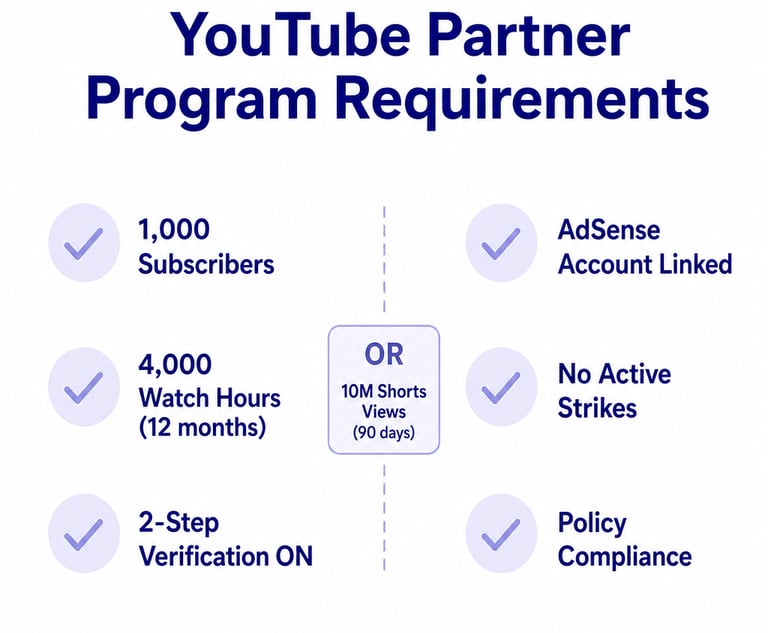
Before you apply, you need to meet every single one of these requirements - not most, all of them.
Subscriber & Watch Time Requirements
YouTube gives you two paths to qualify:
Path 1 - Long-form videos and live streams:
✅ 1,000 channel subscribers
✅ 4,000 valid public watch hours in the last 12 months
Path 2 - YouTube Shorts:
✅ 1,000 channel subscribers
✅ 10 million public Shorts views in the last 90 days
Most Indian creators go the long-form route. The Shorts threshold is genuinely hard to hit unless your content consistently goes viral.
Account Security Requirements
✅ 2-Step Verification (2FA) enabled on your Google Account
✅ Advanced features access enabled in YouTube Studio
✅ Active AdSense for YouTube account linked (or ready to create one)
This is where a lot of creators trip up. You might have every subscriber and watch hour you need, but if 2FA isn't turned on, you can't even submit the application.
Policy Compliance Requirements
✅ No active Community Guidelines strikes
✅ Channel follows YouTube channel monetization policies
✅ Channel is in a supported country/region
India is a supported region, so that one's covered. But the strikes and policy compliance parts are where many channels get stuck - especially gaming and entertainment creators who repurpose trending content.
What "Valid" Watch Hours Actually Means
This is crucial and often misunderstood:
Counts toward 4,000 hours:
Watch time from videos set to public ✅
Long-form videos and live streams only ✅
Accumulated in the last 12 months (rolling window) ✅
Does NOT count:
Private or unlisted video views ❌
Deleted video views ❌
YouTube Shorts views ❌
Ad campaign views ❌
If you've been posting consistently but some of your best-performing videos are unlisted or were deleted, that watch time is gone from your count. Go public or it doesn't exist.
Why YouTube Rejects Monetization Applications
This is the part nobody talks about clearly. YouTube doesn't just reject channels for missing numbers - they reject channels for content quality and policy issues. Here's the breakdown:
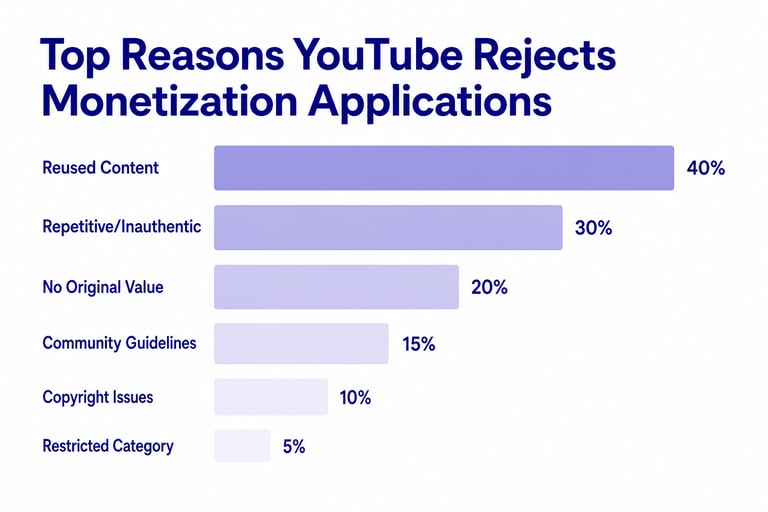
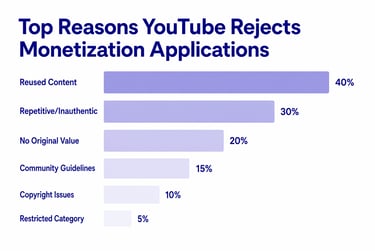
Top Reasons YouTube Rejects Monetization Applications
1. Reused Content - The #1 Killer (40% of Rejections)
Taking someone else's content and reuploading it with minimal changes is the fastest way to get rejected. This includes:
Viral clip compilations
TV show or movie scenes
Content copied from other platforms (Instagram Reels, TikTok)
Cricket highlights or Bollywood clips
The fix: Add your original commentary. Show your face. Demonstrate genuine transformation through your editing, analysis, or perspective. A compilation with your voice explaining each clip is fundamentally different from a compilation with background music.
2. Repetitive or Inauthentic Content (30% of Rejections)
Videos so similar viewers can't tell them apart. YouTube's reviewers look at your entire channel, not individual videos. If everything follows the same template with zero variation, that's a flag.
This includes AI-generated slideshows, text-to-speech reading articles, and mass-produced videos from the same template.
The fix: Vary your format. Add your unique perspective. Show human input in every video. YouTube's monetization policies specifically call out "repetitive content" as a rejection reason.
3. No Original Value or Human Perspective (20% of Rejections)
This one catches creators who think they're making original content but aren't adding enough of themselves to it. Faceless channels with generic commentary, lazy "Top 10" lists, or stock footage with voiceovers fall here.
The fix: Show yourself. Add your personal opinion. Share your actual expertise. Even 10-15 seconds of on-camera presence dramatically improves your approval odds - especially in the Indian market where personal connection drives watch time.
4. Community Guidelines Violations (15% of Rejections)
Active strikes block monetization completely. This covers:
Hate speech, harassment, bullying
Glorifying violence
Health or election misinformation
Inappropriate content targeting minors
The fix: Delete videos with violations, then wait 90 days for strikes to expire before reapplying.
5. Copyright Issues (10% of Rejections)
Copyright strikes (not claims) block monetization. One active strike equals rejection. Three strikes means channel termination.
Note: Copyright claims are different - they don't block monetization (though they do redirect revenue to the rights holder). Strikes are the serious problem.
The fix: Resolve active disputes, remove infringing videos, and use royalty-free music and assets going forward.
6. Restricted Content Category (5% of Rejections)
Some content categories have stricter advertiser rules:
Made-for-kids content
Firearms, alcohol, tobacco, gambling
Controversial political content
Health or medical claims
The fix: Verify your audience settings are accurate. Add educational value. Follow YouTube's advertiser-friendly content guidelines.
The India-Specific Reality Check
Here's something most guides won't tell you: even after you get monetized, YouTube ads alone are rarely enough for Indian creators to earn a full-time income.
Average CPM (Cost Per Mille) in India: $0.30-$2.00 per 1,000 views Comparison: US creators earn $3-$8 per 1,000 views
At 4,000 hours watched, a typical Indian creator might earn Rs 5,000-Rs 20,000 ($60-$240) per month from ads. That's why the smartest Indian creators treat YPP as a foundation, not the destination.
Common Pain Points for Indian Creators
Gaming content saturation: Free Fire, BGMI, and PUBG channels are everywhere. Simple gameplay highlights get rejected. You need original strategy, commentary, or analysis to pass review.
Language dynamics: English content gets higher CPMs but smaller audiences. Regional language content (Hindi, Tamil, Telugu) reaches more people but earns less per view. The sweet spot: record in your regional language, add English subtitles.
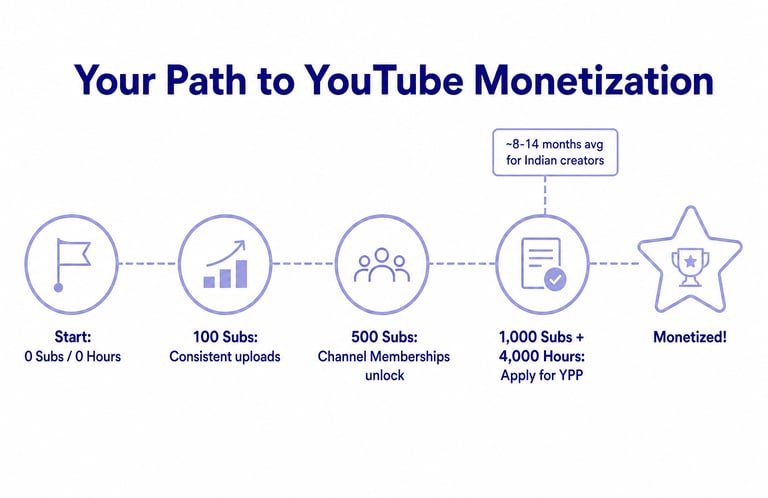
The timeline reality: Hitting 4,000 watch hours typically takes 8-14 months of consistent uploads for most Indian creators. Not weeks. Not months with sporadic content. Consistent, strategic uploading over nearly a year.
Start Earning Before YPP
You don't have to wait for ad revenue to start building income:
Channel Memberships unlock at 500 subscribers + 50,000 channel views (not 4,000 hours)
Super Chat and Super Stickers during live streams - available earlier in the process
Sponsorships - brands often partner at 10,000-100,000 subscribers
Affiliate marketing - Amazon Associates, tech partnerships
Patreon or membership sites - direct audience support
Your Path from Zero to Monetize
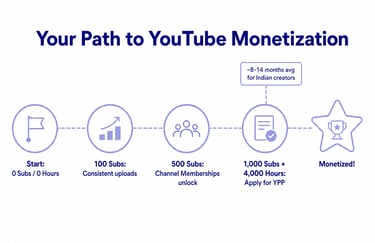
Path to YouTube Monetization Roadmap
The journey isn't random. Here's how to think about it stage by stage:
Stage 1 - Foundation (0-100 subscribers): Focus on finding your niche and your unique angle. What do you bring that nobody else does? Don't copy what's working for others.
Stage 2 - Consistency (100-500 subscribers): Upload on a schedule you can actually maintain. One quality video per week beats three rushed ones. Use playlists to group related content - auto-play means each viewer watches more, which builds watch hours faster.
Stage 3 - Acceleration (500-1,000 subscribers): This is where live streaming becomes your best friend. One 3-hour Hindi live stream with 60+ concurrent viewers generates 180+ watch hours in a single session. Check out our guide on reaching 4,000 watch hours fast for the full strategy.
Stage 4 - Application (1,000+ subscribers + 4,000 hours): Apply through YouTube Studio -> Earn -> Apply Now. Complete all signup steps - including AdSense setup - before entering the review queue. Missing any step means you're not actually in the queue.
Stage 5 - Review and Approval: The typical wait is about 4 weeks. During this time, keep uploading. Your channel activity while under review signals that you're committed and active.
What to Do After a Rejection
Getting rejected isn't the end. Many creators get approved on their second or third attempt.
Option A - Appeal (within 21 days):File an appeal explaining why you disagree with the decision. YouTube reviews it again. This is worth trying, especially if you believe the rejection reason was applied incorrectly.
Option B - Wait and Reapply (after 30 days):Wait 30 days from the rejection date. Fix the identified issues. Upload 5-10 new videos that clearly demonstrate original value and human perspective. Then reapply from scratch.
Most effective approach: Do both. Appeal while preparing improvements. If the appeal is denied, you'll already have stronger content ready for your reapplication.
Debunking the Biggest Monetization Myths
"My videos are original, so I'll get approved" - False. Original + repetitive + faceless = rejection. YouTube wants original and authentic and valuable.
"Faceless channels always get rejected" - False. Faceless channels can succeed, but they need exceptional original value - research, analysis, unique information - to compensate for the missing on-camera presence.
"I need 100+ videos to reapply" - False. Quality beats quantity. 15-20 strong videos that clearly demonstrate your authentic voice are far more effective than 100 generic ones.
"Once rejected, I'm blacklisted" - False. Many creators are approved on their second or third attempt after fixing the specific issues YouTube identified.
"YouTube rejection is random" - False. There is always a specific policy reason. If the email doesn't make it clear, appeal and ask for clarification.
Strategies That Actually Work for Indian Creators
The creators who get monetized fastest in India share a few things in common:
They find their unique angle first. Even in crowded niches - cricket, gaming, tech, finance - there's always a fresh perspective. Instead of cricket highlights, analyze why India lost. Instead of gaming clips, break down strategy. The angle is what YouTube rewards.
They optimize for watch time, not views. One 10-minute video with 80% retention beats one 30-minute video with 20% retention, every time. Watch time earned per video is what pushes you toward 4,000 hours.
They use live streaming strategically. Hindi-language morning discussions, tutorials, and Q&As consistently perform well. One strong live session can generate more watch hours than 10 regular uploads.
They build playlists. Organized content means viewers auto-play into your next video. The compounding effect on watch hours is significant over weeks and months.
Ready to Stop Guessing and Start Growing?
If you've been trying to figure this out alone - analyzing your rejection email, second-guessing your content strategy, wondering if you're close or far - that's exactly the problem YT Verse solves.
YT Verse is a YouTube growth agency built specifically for Indian creators. The approach is a four-step system: deep-dive channel audit -> custom growth blueprint -> execution and optimization -> transparent monthly reporting. Everything is 100% YouTube policy-safe.
Whether you're stuck at watch hours, trying to understand a rejection, or building toward 1,000 subscribers for the first time, a proper strategy audit cuts months off your timeline.
-> See how YT Verse helps creators get monetized faster
Frequently Asked Questions
How many subscribers do you need for YouTube monetization in 2026?
You need 1,000 subscribers plus either 4,000 valid public watch hours in the last 12 months (for long-form content) or 10 million public Shorts views in the last 90 days.
Why did YouTube reject my monetization application?
The most common causes: reused content (40%), repetitive or automated videos (30%), no original value or human perspective (20%), community guidelines violations (15%), and copyright strikes (10%). There's always a specific policy reason - never random.
How long does YouTube monetization review take in 2026?
Typically about 4 weeks. High application volumes or cases where multiple reviewers disagree can extend this.
Can I reapply after rejection?
Yes. Appeal within 21 days, or wait 30 days and reapply after fixing the issues. Many creators are approved on their 2nd or 3rd attempt.
Do private or unlisted videos count toward 4,000 watch hours?
No. Only public videos count. Private, unlisted, and deleted video views - plus all Shorts views - don't contribute to the 4,000-hour requirement.
What's the fastest way to get 4,000 watch hours as an Indian creator?
Live streaming is the fastest method. A 3-hour Hindi live stream with 60+ concurrent viewers generates 180+ watch hours in one session. Combine this with consistent uploads and strategic playlist organization. Read our complete watch hours guide for more tactics.