
YouTube CPM and RPM in India: Why You Earn Less and How to Fix It (2026)
Indian creators earn 60-75% less per view than US creators. Here's exactly why CPM is so low in India, which niches pay more, and the proven strategies to increase your RPM starting today.
Utkarsh Agrawal
6/4/20268 min read
Many Indian creators check their first YouTube payout and feel a pit in their stomach. They've built an audience, hit 100K views, but the earnings feel like a rounding error. A US creator earning $300 from 100K views would make a life-changing amount of money in India. You're not failing-you're just playing on an uneven field.
Your YouTube CPM in India is probably $0.30 to $2.00 per 1,000 ad impressions. In the US? $3 to $8. That gap isn't about your content quality. It's about market economics, advertiser demand, and how YouTube's algorithm distributes ads across regions. Understanding this gap is the first step to actually earning a real income from YouTube.
Let's break down exactly why Indian CPM is low, which niches pay better, and the concrete strategies to increase your RPM starting now.
CPM vs RPM: The Difference That Explains Your Earnings
Most creators conflate CPM and RPM, and that confusion costs them money.
CPM = Cost Per Mille. This is what advertisers pay YouTube for every 1,000 ad impressions served. CPM is the wholesale price, not your price.
RPM = Revenue Per Mille. This is what you actually earn per 1,000 views, after YouTube takes its cut (usually 45%). RPM is the retail price in your pocket.
If an ad has a $2 CPM, YouTube keeps 90 cents and you get $1.10-that's your RPM. When creators obsess over CPM numbers, they're chasing the wrong metric. You can't control CPM directly. You can optimize for RPM by making content that commands higher advertiser demand.
Your real monthly earnings work like this: (Views ÷ 1,000) × RPM = Monthly AdSense Revenue
At 100K views/month with a ₹50 RPM (about $0.60), you earn ₹5,000/month. A YouTuber with the same views in finance content at ₹200 RPM earns ₹20,000/month. Same effort. Same platform. Different niche, drastically different income.
Why Indian YouTube CPM Is So Low (The Honest Answer)
Here's what YouTube won't tell you: CPM is dictated by advertiser demand, not by your content quality.
When an advertiser creates a campaign, they set a budget for each geographic region. US and UK advertisers have massive budgets because consumers there spend more money. They bid higher for ad slots. When demand is high, CPM goes up. When demand is low, CPM drops.
India's CPM is low for three reasons:
1. Advertiser budgets are regional, not global
A US e-commerce brand selling $300 products to Americans will bid $5-8 per thousand impressions because their profit margin is huge. An Indian brand selling ₹500 products can only afford to bid ₹30-50 per thousand impressions. YouTube serves ads based on highest bidder. When most ads are from lower-budget Indian advertisers, CPM stays low.
2. Most ads served to Indian creators are from Indian advertisers
YouTube's algorithm prioritizes matching advertiser intent with audience. An Indian fashion brand wants to reach Indian users. A US investment app wants to reach US users. If your viewers are 80%+ Indian, most ads are from Indian advertisers with smaller budgets. Same content, different audience geography = different CPM.
3. Wealth inequality matters
It's brutal but true: the US and UK have higher purchasing power per capita. Advertisers make more profit from US customers. They'll spend more to reach them. This isn't YouTube's fault-it's global economics. A creator with 50% US/Canadian audience will see 3-4x higher CPM than a creator with 100% Indian audience, regardless of niche.
None of this is fixable through better thumbnails or titles. It's baked into the market.
What Your Niche Is Doing to Your Earnings (CPM by Category)
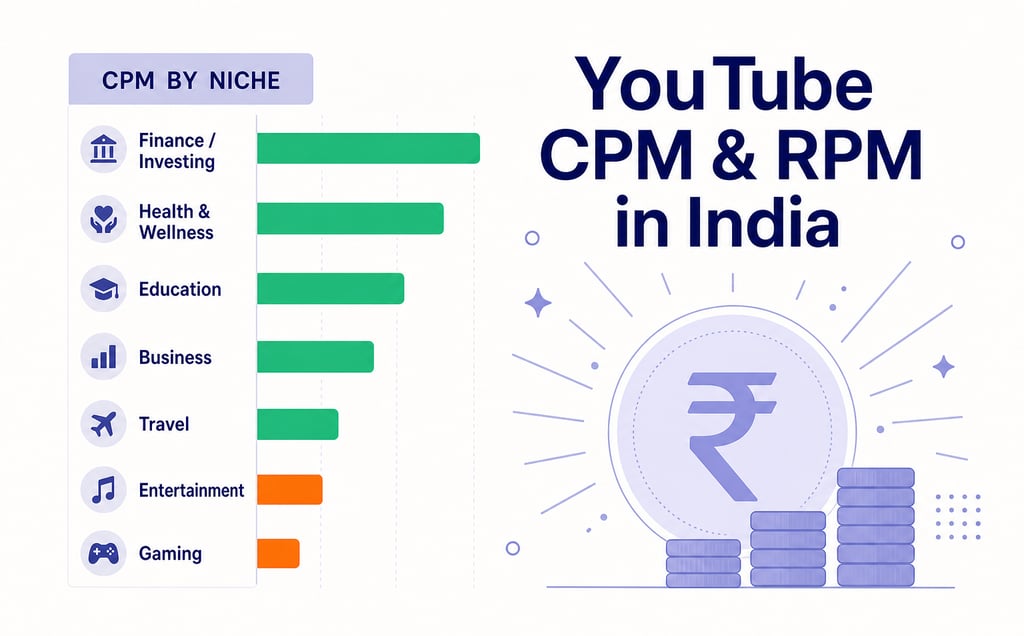
CPM variance by niche is massive. This is the one thing you can actually control.
High-CPM Niches in India (₹160-₹400+/1,000 views):
Finance & investing
Business & entrepreneurship
Real estate & property investment
Digital marketing & SaaS
Stock market & cryptocurrency
These niches attract advertisers with big budgets (financial services, course creators, real estate developers). Advertiser intent is high, so CPM rises.
Medium-CPM Niches in India (₹60-₹150/1,000 views):
Technology & gadgets
Educational content
Personal development
Productivity tools
Health & fitness
Low-CPM Niches in India (₹20-₹80/1,000 views):
Entertainment & comedy
Gaming & esports
Mukbang, vlogs, shorts
Music & cover songs
Lifestyle & fashion
Why the gap? Entertainment content attracts ads from small brands, local businesses, and low-bid networks. Finance content attracts Zerodha, Upstox, investment apps, and US fintech companies bidding aggressively.
Real numbers: A finance YouTuber with 100K views might earn ₹20,000-30,000. An entertainment creator with the same 100K views earns ₹3,000-5,000. Same audience size. One is earning 5-6x more because of niche.
If you're in low-CPM content, this is exactly why understanding your audience matters for channel growth. You're not failing-your niche just has lower advertiser demand. The fix isn't harder work. It's intentional positioning toward higher-intent audiences.
Seasonal CPM: The Q4 Goldmine Indian Creators Miss
CPM isn't constant year-round. It spikes and dips seasonally, and most Indian creators don't plan for it.
Q4 (October-December): 2-3x higher CPM
Diwali festive season: Indian advertisers spend heavily
Holiday season (US/UK): Western brands spend on Black Friday, Cyber Monday, Christmas
New Year campaigns: Finance, fitness, and self-help brands launch campaigns
Q1 (January-March): Moderate CPM (near average)
Q2 (April-June): 30-40% lower CPM
Post-holiday spending drop
Summer slowdown for many industries
Q3 (July-September): Near average, slight dip
Strategic insight: If you can, plan your highest-effort content for Q4. A 10-video series in October will earn 2-3x more from the same views than the same series in May. Indian creators routinely upload their best work in March and wonder why earnings are disappointing. Flip the calendar.
How to Actually Increase Your YouTube RPM in India
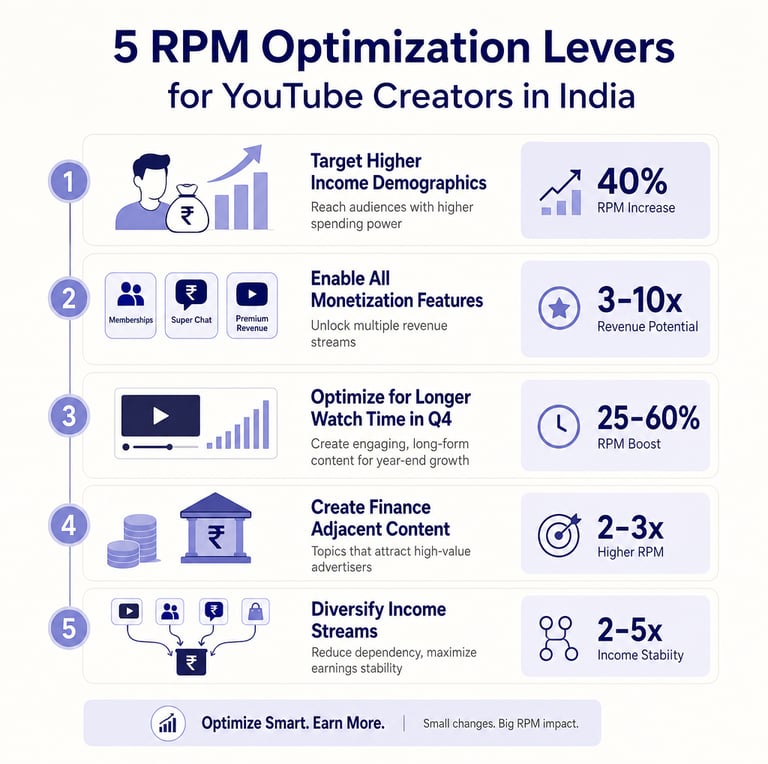
You can't change CPM directly. But you can optimize for RPM through these proven levers:
1. Target higher-income demographics
If your content appeals to affluent audiences-people with disposable income, business owners, investors-advertiser demand rises. Finance and business content works because the audience has money. An entertainment channel targeting college students will have lower CPM than education content targeting young professionals. Same platform, different audience wealth = different advertiser interest.
Actionable: Audit your audience demographics in YouTube Studio. What's their household income estimate? Are they in cities with higher purchasing power? If your audience is primarily tier-2/3 cities, consider repositioning toward tier-1 + global audiences.
2. Enable all monetization features, not just ads
RPM includes ads, but also:
Channel memberships (your revenue from member fees)
Super Chat (fan donations during streams)
Super Thanks (viewers paying for video notifications)
YouTube Premium revenue (share of subscription fees)
A creator with 100K views earning ₹50 from ads alone might earn ₹70-80 total RPM with all features enabled. That's a 40% increase with zero extra effort. Most Indian creators overlook memberships and Super Chat.
Actionable: Enable memberships today. Design 2-3 member-only perks (early access, exclusive community post). Mention it once per video. You won't get many members at first, but a 5% conversion of viewers to members changes your RPM significantly.
3. Optimize content for longer watch time in high-CPM periods
Content that keeps viewers watching longer tends to get served more ads and higher-quality ads. Longer videos = more ad slots = more RPM. This is especially powerful during Q4 when advertiser demand is highest.
Actionable: In Q4 (Oct-Dec), stretch your video format from 8 minutes to 12-15 minutes. Add deeper storytelling, multiple chapters, or bonus sections. More watch time in a high-CPM season compounds your earnings.
4. Create finance or business adjacent content
If you're in a lower-CPM niche (entertainment, gaming, lifestyle), consider adding finance/investing angles. A gaming channel talking about "how much pro gamers earn and where money comes from" attracts finance advertisers. An entertainment channel with a "startup lesson" series gets different ad demand.
You don't need to pivot your entire channel. Even 20% of content in higher-CPM adjacent topics can lift your overall RPM by 30-50%.
5. Diversify income immediately
Ad revenue is volatile and low for most Indian creators. The moment you hit 1,000 subscribers:
Start pursuing brand deals (typically 3-10x ad revenue for same views)
Join affiliate programs (Amazon, Flipkart, tech products)
Create digital products (courses, templates, toolkits)
Offer services (consulting, coaching, editing)
A creator earning ₹5,000/month from ads might earn ₹50,000/month from brand deals once they build a brand reputation. Ads are the starting point, not the destination.
Realistic Income Expectations at Every Stage
Stop comparing yourself to US creators earning thousands per month. Here's what real Indian YouTube earnings look like:
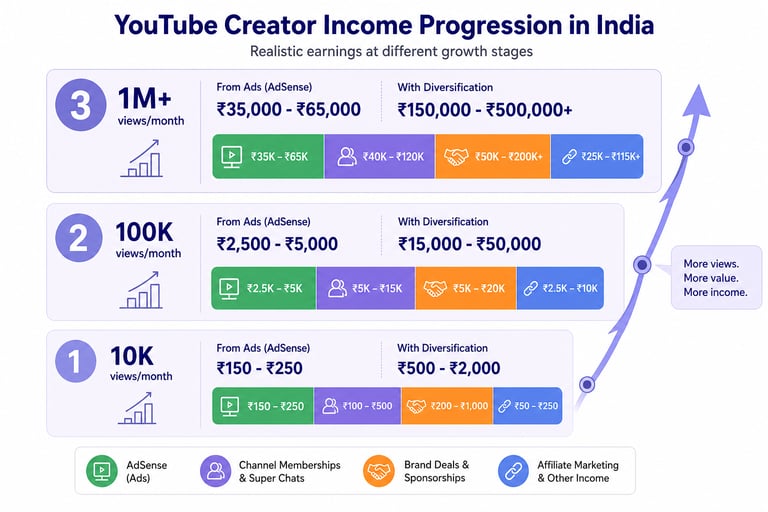
At 10K views/month:
Average CPM: ₹30-40
Average RPM: ₹15-25
Monthly AdSense earnings: ₹150-250 (₹5-8 USD)
With diversification: ₹500-2,000/month possible
At 100K views/month:
Average CPM: ₹40-60
Average RPM: ₹25-50
Monthly AdSense earnings: ₹2,500-5,000 ($30-60 USD)
With diversification: ₹15,000-50,000/month possible
At 1M views/month (100K subscribers minimum):
Average CPM: ₹60-100
Average RPM: ₹35-65
Monthly AdSense earnings: ₹35,000-65,000 ($420-780 USD)
With diversification: ₹150,000-500,000/month possible
The numbers feel small at early stages. They're supposed to. YouTube earnings are back-loaded. The real money comes at 500K+ views/month, when brand deals and diversification kick in.
What matters is trajectory. If you're growing from 10K to 100K views over 8-12 months, and adding memberships and affiliate income, your total creator income starts looking like a real job. That's the play.
Beyond Ad Revenue: Building Real Income as an Indian Creator
Here's the unspoken truth: YouTube AdSense alone will never pay your bills as an Indian creator. You need a diversified income stack.
A finance creator with 200K/month views might earn:
YouTube ads: ₹12,000
Memberships: ₹3,000
Brand deals: ₹40,000
Affiliate links: ₹5,000
Total: ₹60,000/month
Without diversification, they'd earn ₹12,000. The difference is life-changing.
The real income sequence:
Month 1-6: Focus on building audience. Earnings are near-zero.
Month 6-12: Hit 1,000 subscribers. Enable memberships. Launch first brand deal.
Month 12-18: Hit 10K subscribers. AdSense becomes meaningful ($10-20/month). Brand deals are regular. This is now a real income stream.
Month 18+: Compound effect. Passive income from memberships, affiliate sales, and repeat brand partners. AdSense is the bonus, not the goal.
Understanding how the YouTube algorithm works helps you grow faster. But understanding how money works is what turns growth into income. Build for algorithmic growth. But monetize through diversification.
Frequently Asked Questions
What's the difference between CPM and RPM on YouTube?
CPM (Cost Per Mille) is what advertisers pay for 1,000 ad impressions. RPM (Revenue Per Mille) is what you actually earn per 1,000 views after YouTube's 45% cut. If CPM is $2, your RPM is roughly $1.10. Always focus on RPM-that's your real income.
Why is Indian YouTube CPM so low compared to other countries?
Advertiser demand drives CPM. Western markets (US, UK, Canada) have higher purchasing power and bigger advertising budgets. India's CPM is lower because most ads are served to lower-cost regional markets and local Indian advertisers have smaller budgets. It's market economics, not a YouTube policy.
Which YouTube niches have the highest CPM in India?
Finance, investing, and business content earn the highest CPM (₹160-₹400+ per 1,000 views). Technology and SaaS follow. Entertainment, gaming, and lifestyle content earn the lowest (₹30-₹100 per 1,000 views). Your niche dramatically impacts earnings-a finance channel with 100K views could earn 5x more than an entertainment channel with the same views.
How much can I realistically earn with 100K views per month in India?
With 100K views and an RPM of ₹50 (average across niches), you'd earn ₹5,000/month from ads alone-roughly $60 USD. But if you're in finance or business, you could hit ₹20,000+ ($240+). The range is huge. Diversify with brand deals, memberships, and Super Chat to 3-10x your ad revenue.
Does the time of year affect my YouTube CPM in India?
Absolutely. Q4 (October-December) during Diwali and holiday season sees 2-3x higher CPM because Indian and global advertisers spend more on festive promotions. Plan high-effort content for Q4 if possible. RPM during April-May typically drops 30-40% by comparison.
Try ytverse.in for Accelerated Growth
If you're serious about building a real YouTube income in India, algorithmic growth is non-negotiable. ytverse.in helps Indian creators optimize for the algorithm, reach the monetization milestones faster, and build sustainable income streams beyond ads.
We work with creators on how to get 4,000 watch hours quickly and proven strategies to grow your channel in India. If you're hitting a plateau, dealing with low CPM frustration, or just trying to understand why your earnings don't match your effort, we can help you strategize the real levers that matter.
The gap between Indian and Western creator earnings is real. But it's not insurmountable. It just takes strategy, patience, and income diversification. We help creators do exactly that.