
YouTube Monetization Rejected? Here's How to Appeal & Get Approved
Your monetization was rejected or disabled? Follow this exact 4-step process to appeal and get re-approved.
Utkarsh Agrawal
5/28/20268 min read
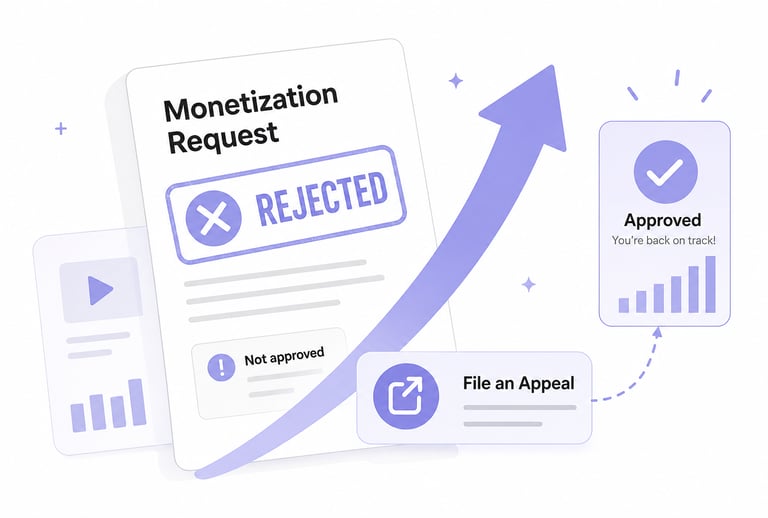
You built for months. Your numbers were solid. You hit the watch hours. You crossed the subscriber threshold. And then YouTube hit reject.
A monetization rejection stings, but here's what most creators don't know: it's not final. You have 21 days to appeal. Your appeal goes to a different reviewer than the one who said no. And if you do it right - if you're specific, calm, and address their actual reason - you have a real shot at reversing the decision.
This guide walks you through the entire appeal process. When to appeal versus when to reapply. What to write. What not to write. What to expect. And how to set yourself up to win.
Appeal vs Reapply: Which Path Is Right for You
This choice matters. Pick wrong and you waste your 21-day window or walk into a reapplication you're not ready for.
Appeal if:
You believe YouTube misunderstood your content or misapplied their policy
Your channel has genuinely original value that the first reviewer missed
You've already made improvements (removed problem videos, updated descriptions, made creative changes) that address the reason
The rejection reason doesn't accurately describe what's actually on your channel
Reapply if:
You know your channel has real issues - heavy reused content, borderline Community Guidelines violations, repetitive format without original spin
You need time to rebuild and upload clearly original material
You're not confident arguing against the reason given
You want a clean slate without the baggage of the first review
The hard truth: if your channel actually does have mostly reused or repetitive content, appealing won't fix it. A better-written appeal doesn't change what YouTube sees when they look at your videos. You need to actually fix the content first, then reapply.
But if you know your channel is solid and the decision felt wrong, appeal fast. You have three weeks.
The 21-Day Appeal Window (What You Can and Can't Do)
The moment you get the rejection email, you can appeal. You have exactly 21 days from that date. On day 22, the appeal window closes.
During those 21 days:
You can:
File one appeal
Include new context about your channel
Address the specific rejection reason
Reference videos and timestamps
You cannot:
Submit multiple appeals (one shot)
Appeal a denied appeal immediately (30-day wait applies after denial)
Reapply without waiting 30 days from original rejection
Plan to submit your appeal by day 18-19. Don't wait until day 21 - if you hit a technical glitch or want to revise, you'll want buffer time.
Step-by-Step: How to File a YouTube Monetization Appeal
YouTube's appeal form is simple on the surface. Here's exactly where to find it and what to do.
Step 1: Find the appeal option in YouTube Studio
Go to YouTube Studio → Monetization (left sidebar). You'll see a notification about the rejection. There's an "Appeal" button right there. Click it.
Step 2: Read the rejection reason carefully
YouTube will show you why they rejected you. Common reasons:
Reused content (videos too similar to existing material)
Insufficient original content
Community Guidelines violations (usually copyright strikes or Copyright claims, sometimes milder policy issues)
Channel doesn't meet policy requirements
Borderline content (sometimes a judgment call that can go either way)
Write this reason down. Your appeal will address it directly.
Step 3: Prepare your counter-argument
Before you type in the appeal box, outline what you're going to say:
Do you disagree with the reason given?
Which specific videos prove they're wrong?
What's your creative process? What makes your content original?
Have you fixed anything since the original review?
Step 4: Write your appeal (form in next section)
Type your appeal into the text box. Keep it under 500 words. Be specific. Be professional. Cite video titles and timestamps.
Step 5: Submit
Click submit. You'll get a confirmation that your appeal was received.
Step 6: Wait
YouTube typically responds in 1-2 weeks. Some take longer. You'll get an email with the decision.
What to Write in Your Appeal (with template guidance)
Your appeal has to land in the first 30 seconds. A different reviewer will read it cold. They need to understand your argument fast and see evidence immediately.
Structure your appeal in three parts:
Part 1: Politely disagree with the specific reason (2-3 sentences)
"I received a rejection stating [exact reason]. I respectfully disagree with this assessment because [your main argument]. My channel contains original content and creative value that this decision doesn't reflect."
Example: "My channel was rejected for 'reused content,' but my videos are original commentary and analysis on trending YouTube topics. Each video includes my unique perspective, original graphics, and voice-over. The rejection doesn't align with what's actually on my channel."
Part 2: Cite specific evidence (3-5 videos with timestamps)
List actual videos. Give titles. Give timestamps if there's a specific moment that proves your point. Be exact.
"I'd like to highlight these specific videos that demonstrate original value:
[Video Title] (timestamp 2:15-3:45) - shows [specific original element]
[Video Title] (timestamp 0:00-1:30) - demonstrates [original contribution]
[Video Title] - showcases [your unique angle]"
Part 3: Explain your creative process and what's next (2-3 sentences)
"My creative process involves [brief description of how you make content]. I've [mention any improvements you've made]. Moving forward, I'm committed to [your plan for the channel]."
Example: "I research trending topics, create original analysis, and add custom graphics and commentary. I've reviewed my older content and removed videos that didn't meet my current standards. Moving forward, every video will follow a consistent format emphasizing original analysis and creator voice."
Template (customize and fill in):
I received a rejection stating [REASON]. I respectfully disagree because [MAIN ARGUMENT].
My channel contains original content that doesn't align with this assessment. I'd like to highlight these specific videos:
[TITLE] (timestamp X:XX-X:XX) - [original element]
[TITLE] (timestamp X:XX-X:XX) - [original element]
[TITLE] - [original element]
My creative process involves [PROCESS]. I've [any improvements made]. I'm committed to maintaining [your channel's direction].
Thank you for reconsidering.
What makes this work:
Specific, not vague - you're not saying "my content is original," you're showing exactly which videos and what makes them original
Addresses their reason directly - you're not ignoring what they said, you're countering it with evidence
Professional and calm - no frustration, no drama, no threats
Evidence-based - timestamps and video titles let them verify what you're saying
Keep it tight. Under 500 words. The reviewer will skim. Make every sentence count.
What NOT to Include in Your Appeal
This is where most appeals fail.
Don't:
Express anger or frustration - "This is ridiculous" or "I can't believe you rejected me" signals you're emotional, not logical. Stay calm even if you're furious.
Make vague claims - "My content is original" without evidence. They've already disagreed with that statement. Prove it.
Copy boilerplate from the internet - generic appeal templates are visible from space. Use the structure above but write your own content.
List videos without explaining why they matter - if you cite a video, tell them what makes it original. Don't assume they'll see it.
Mention that other channels do the same thing - "Everyone makes commentary videos" is not a defense. You're not defending your peers, you're defending your channel.
Threaten to leave YouTube - don't say "if you don't approve me I'm switching platforms." That's a threat, not an argument.
Dispute their interpretation of policy - don't argue that reused content is fine actually. Accept the policy and argue that your content doesn't violate it.
Mention this is your only income - YouTube's decision doesn't change based on financial need. Focus on the content.
The tone kills more appeals than the argument. Professional, specific, respectful.
What Happens After You Submit (timeline and expectations)
You've hit submit. Now what?
Days 1-3: Nothing visible. Your appeal is in the queue.
Days 3-7: You might get a response. Most appeals are reviewed within a week.
Days 7-14: If it's been more than a week, you're waiting on secondary review or they're being thorough. This is actually a good sign - it means a human is actually looking at your material.
Days 14+: Some appeals take up to 3 weeks. Patience.
What the response looks like:
YouTube sends an email. It's either:
Approved - "Your appeal has been approved. Your channel is now eligible for monetization." You're done. Monetization usually activates within 24 hours.
Denied - "We've reviewed your appeal and our original decision stands. You can reapply in 30 days."
There's rarely additional explanation. They don't tell you why they denied you or which specific videos caused the issue. It's binary: yes or no.
If Your Appeal Is Denied: The 30-Day Reapplication Strategy
Okay, they said no. That sucks. But you're not locked out forever.
You have to wait 30 days from the original rejection date. On day 31, you can reapply fresh. No appeal this time - just a new monetization request.
Those 30 days are your rebuild window. Use them.
Days 1-7: Review your entire channel
Watch your own videos like a YouTube reviewer would. Look for:
Reused content - are you reformatting the same ideas across multiple videos?
Low production value - rough editing, poor audio, minimal effort?
Policy edge cases - anything that could be flagged? Music without rights? Community Guidelines friction?
Consistency - does your upload schedule feel active or abandoned?
Days 8-21: Create new original content
Upload 5-10 brand-new videos that are clearly original. Not borderline. Not repackaged. Genuinely new ideas with your unique angle. This is what the next reviewer will see first.
Quality over quantity. Two excellent videos beat five mediocre ones.
Days 22-30: Polish everything else
Update channel description and branding
Refresh playlists to highlight your best original work
Pin your strongest video
Review Community Guidelines and confirm you're clean
Making Your Reapplication Bulletproof
When day 31 arrives and you reapply, you're starting fresh. The second reviewer doesn't see your previous appeal or the first reviewer's notes (usually). They see your channel as it exists right now.
What this means:
Your new videos matter a lot. They're the first thing the reviewer sees.
Quality is the filter. If your new uploads are weak, you lose before they even look at older content.
Channel health matters. Activity, consistency, engagement all signal you're serious.
Reapplication best practices:
Make sure your 5-10 new videos are genuinely solid - they set the tone for the entire review
Diversify your content slightly - if you got flagged for repetition, show range
Document your channel improvements - in your own notes, not in the application (YouTube doesn't ask). But know what you fixed
Don't repeat the exact same appeal language - you're starting fresh, so write a new application that reflects the new you
Wait the full 30 days - don't try to reapply on day 29. Give yourself a true clean slate
YouTube's system isn't personal. It's pattern-matching. If you genuinely change the patterns (less repetition, more originality, cleaner channel state), the outcome changes.
Frequently Asked Questions
How long do I have to appeal a YouTube monetization rejection?
You have 21 days from the date of rejection to file an appeal. After 21 days, your only option is to wait 30 days from rejection and reapply fresh. Check with Ytverse for guidance on timing your next steps.
What's the difference between appealing and reapplying?
An appeal tells YouTube you disagree with their decision and asks them to reconsider. A reapplication means you're starting fresh after waiting 30 days. Choose appeal if you believe the rejection was wrong; choose reapply if you know your channel needs fixes first. Learn how to grow faster while you wait.
Will YouTube explain why my monetization was rejected?
YouTube provides a rejection reason but doesn't go into detail or explain the specific videos that triggered it. Your appeal is your chance to address that reason directly and prove it doesn't apply to your channel. Be specific about which videos show original value.
What happens if my appeal is denied?
If denied, you must wait 30 days from the original rejection date before reapplying. Use that time to upload 5-10 clearly original videos, audit your channel for any policy edge cases, and make sure your content genuinely differentiates. Build a stronger foundation before your next attempt.
What's the success rate for YouTube monetization appeals?
Roughly 30-40% of appeals succeed when creators have a legitimate case (wrong rejection, misapplied policy, minor guideline issues since corrected). Success depends on how strong your counter-argument is and whether you genuinely meet the policy requirements.
Try Ytverse
Getting rejected for monetization doesn't mean your channel isn't ready - sometimes it means the path forward isn't obvious. Ytverse.in helps creators navigate exactly this moment. Whether you're building toward monetization, recovering from rejection, or scaling past your first 1,000 subscribers, Ytverse specializes in the Indian creator journey.
They've helped creators hit 1,000 subscribers fast and accelerate toward 4,000 watch hours without the guesswork. If you're ready to move past the rejection and into real growth, that's where to start.