
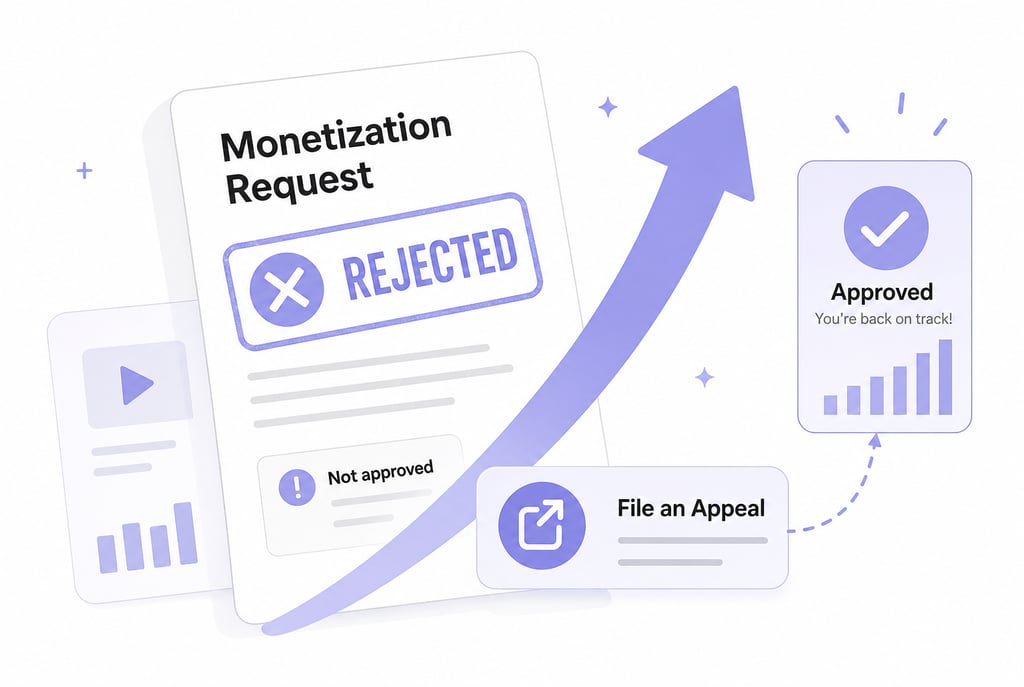
YouTube Monetization Rejected for Reused Content - How to Fix It and Reapply
Got rejected for reused content on YouTube? Learn what it means, why it happens, and the exact steps to fix it and reapply for monetization. Guide for Indian creators.
Utkarsh Agrawal
6/23/202612 min read
Introduction: The Reused Content Rejection Nobody Wants
Your channel hit 1,000 subscribers. You've been uploading for months. The watch time is building. And then you get the email: "Your channel doesn't meet our Partner Program requirements. Reason: Reused Content."
Your stomach drops.
If this happened to you, you're not alone. Thousands of Indian creators - especially reaction channels, compilation channels, and commentary creators - get this rejection every month. The good news? It's fixable, and you can reapply.
The bad news? YouTube isn't always super clear about what "reused content" actually means, or how to fix it.
This guide will walk you through exactly what YouTube means by "reused content," why your channel got rejected, and the specific steps to fix it and get approved. We'll also cover how to write an appeal that actually works, and when you're ready to reapply.
Let's dive in.
What Does "Reused Content" Actually Mean According to YouTube?
YouTube's definition of "reused content" sounds simple on the surface, but it's where most creators get confused.
According to YouTube's Partner Program policies, reused content is material that has already been published on YouTube - or elsewhere - with little to no additional value or modification from you.
Here's the key part: YouTube doesn't care if you're uploading someone else's work. YouTube cares if you're uploading work without adding meaningful original contribution to it.
There's a big difference.
The YouTube Policy, Broken Down
YouTube's official stance is this:
"Do not simply re-upload videos that have already been published on your channel or other channels. Content should be original and substantially different from other versions of the same content."
What does "substantially different" mean? That's where creators get stuck.
YouTube looks for:
Original commentary that adds new perspective or analysis
Unique editing that creates new value
Significant transformation that makes it meaningfully different from the source material
Fair use principles (but more on that in a moment)
If you upload a trending song, a famous movie clip, or someone else's video with no changes? That's reused content. If you upload someone else's gaming footage, music video, or educational content without adding substantially to it? Same problem.
But if you're a reaction channel with real, genuine reactions and commentary? If you're a compilation channel that curates, organizes, and adds context? If you're doing commentary or analysis that genuinely transforms the material? That's different. That might be fine - but it depends on how much original value you're adding.
Why Does YouTube Reject Channels for Reused Content?
YouTube's Partner Program is where creators make money. YouTube wants to pay creators who are building audiences and adding value to the platform.
If creators just re-uploaded viral videos or copied content from other channels, YouTube would:
Dilute the platform with duplicate content
Hurt the original creators (who lose views)
Waste server space on repetitive material
Reduce user experience (why watch the same thing twice?)
Attract spammers and low-effort creators
So YouTube draws a line: you can use others' content, but you need to transform it meaningfully and add original value.
The challenge is that YouTube's moderation isn't always perfect. Sometimes channels that should pass (like legitimate reaction or commentary channels) get flagged. Sometimes channels that should fail slip through.
But the rule itself exists for a reason: to keep the platform quality high and creators honest.
Which Channels Commonly Get Hit With the "Reused Content" Rejection?
This is crucial to understand, because your channel type affects how you fix the problem.
1. Reaction Channels
Reaction channels are HUGE in India. You film yourself reacting to viral videos, movie trailers, songs, or trending clips.
The problem? If your reaction is just you sitting in front of the screen saying "wow, that's crazy" - with no real commentary, no expert insight, no original angle - YouTube will reject you for reused content.
But if your reaction includes genuine analysis, backstory, technical expertise, or original humor? That can work.
Example: A channel that reacts to Bollywood trailers by breaking down the cinematography, comparing it to past films, and analyzing the director's choices - that's adding value. A channel that just films you watching with generic expressions - that's not.
2. Compilation Channels
These channels stitch together clips - from movies, TV shows, YouTube videos, sports moments - into themed compilations.
The rejection here is similar: if you just mash clips together with no curation, no context, no narrative - it's reused content. But if you curate carefully, add intros/outros, provide context, organize by theme, and create a journey for the viewer - it's transformative.
Example: A channel that compiles "Viral Indian TikTok Moments" with no organization is reused content. A channel that compiles "The Best Educational TikTok Hacks for Students" with commentary, context, and original framing - that adds value.
3. Commentary/Critique Channels
These channels take existing content (videos, articles, trends, drama) and add your own commentary, critique, or analysis.
If your commentary is genuinely original and makes up a significant portion of the video, this usually passes. If your commentary is thin and the original content dominates, it fails.
Example: A creator who watches viral Indian YouTuber drama and adds 10 minutes of original analysis and opinion - that's commentary. A creator who just re-uploads the original drama clips with a 30-second intro - that's reused content.
4. Educational Repurposing Channels
Some creators take educational content (lectures, tutorials, research) and repackage it for different audiences.
If you're adding significant original teaching, context, or transformation, it can work. If you're just reposting, it won't.
Example: A teacher who records their own lectures - that's original. A teacher who records someone else's lectures from an online course and re-uploads them - that's reused content.
5. Gaming Channels (Without Original Gameplay)
Some channels upload gaming footage from games that don't belong to them, without adding commentary or original entertainment value. This is the clearest reused content violation.
6. Movie/Music Reaction or Upload Channels
Uploading full movies, full songs, or full movie scenes? YouTube will see this as reused content - usually flagged immediately.
What Actually Counts as "Meaningful Original Commentary"?
This is the gray zone where most creators need clarity.
YouTube doesn't define "meaningful" with exact percentages or time limits. But here's what creators who pass the review typically have:
Characteristics of Strong Original Commentary:
It's Substantive - Your commentary isn't just "That's so good!" or generic reactions. It includes analysis, opinion, expertise, or insight that viewers couldn't get from the original content alone.
It's Present Throughout - Your commentary doesn't just appear at the beginning and end. It's woven through the content, transforming the viewer's experience.
It's Original - You're not copying someone else's analysis. Your take, your angle, your perspective.
It Adds Educational or Entertainment Value - Viewers watch your version to learn something new or be entertained in a way they wouldn't be from the original.
The Original Content Isn't the Star - The original clip is supporting material. Your commentary is the reason someone watches.
Red Flags That Fail This Test:
❌ Uploading the original content with a 10-second intro ("Hey, watch this viral video")
❌ Generic reactions without specific insight or expertise
❌ Heavy background clips with minimal original footage or voiceover
❌ Copying other creators' commentary styles or takes
❌ Stating the obvious about what's happening on screen
❌ Reactions that could apply to any content (always the same expressions, phrases, energy)
How to Audit Your Channel and Find the Problem
Before you reapply, you need to honestly assess your content.
Step 1: Watch Your Videos Like a Stranger
Open your channel. Pick your last 10 videos. Watch them as if you've never seen them before.
Ask yourself:
If the original content (the clip, footage, or source material) was removed, would this video still be interesting?
What am I adding that the original didn't have?
Could someone get the same value by just watching the original source?
Is my commentary expert-level, entertainer-level, or surface-level?
Be brutally honest. This isn't about pride. It's about understanding YouTube's perspective.
Step 2: Measure Your Original Content vs. Source Content
Go through 5-10 of your longest videos. Calculate roughly:
What % of screen time is original (you talking, your footage, your editing)?
What % is source content (the clip you're reacting to/discussing)?
General rule of thumb (not official, but what creators who pass tend to hit):
Reaction channels: 30-50% original you, 50-70% source material
Commentary channels: 40-60% original you, 40-60% source material
Compilation channels: 20-40% original you, 60-80% source material (but with heavy curation and context)
If you're at 10% you and 90% source content, you've found your problem.
Step 3: Check for Copyright Claims
Log into YouTube Studio. Go to Videos → review each video.
Look for Copyright Claims (yellow flag icon). If your videos have dozens of copyright claims, you're using a lot of protected material.
Look for Monetization Status. Some videos might show "Monetization limited" or "Not eligible."
Copyright claims don't automatically mean "reused content rejection," but they're a signal that you're using a lot of others' material.
Step 4: Look at Your Titles and Descriptions
Do your titles and descriptions make it sound like you're just sharing someone else's content?
❌ Bad: "Watch This Viral Video"
✅ Good: "Why This Viral Video is a Masterclass in Editing (Analysis)"
❌ Bad: "Compilation of Trending TikToks"
✅ Good: "5 TikTok Trends That Explain Modern Indian Youth - Breakdown"
Your titles should make clear that you're adding your own take.
Step 5: Compare to Approved Channels in Your Niche
Find 3-5 channels in your niche that have been monetized. Study their content.
How much original content do they add? How do they structure their videos? What's their commentary style? How long are their videos?
This isn't about copying them. It's about understanding the baseline.
Specific Fixes to Make Before Reapplying
Once you've identified the problem, here's how to fix it:
For Reaction Channels:
Add Expert or Unique Commentary - If you're reacting to music, have you studied music production? If you're reacting to film, do you know cinematography? If you're reacting to tech, do you test products? Depth matters.
Create Original Segments - Add original segments like "What This Video Gets Wrong," "Technical Breakdown," "Comparison to Last Year's Version," "Why This Matters in India."
Increase Your Screen Time - Film yourself in higher quality. Take up more of the screen. Make the viewer invested in you, not just the clip.
Add Original Editing - Don't just split-screen the original and you. Add graphics, text overlays, cutaways, B-roll that's yours. Make it visually yours.
Longer, Deeper Reactions - Shallow 5-minute reactions to 3-minute clips don't add much. Dive deep. 15-20 minute reactions with real analysis work better.
For Compilation Channels:
Add Introductions and Transitions - Don't just splice clips. Create original intro footage, transitions, and outros. Film yourself.
Provide Context - In your voiceover, explain why you're showing this clip. What's the story? What does it mean?
Curate Carefully - Don't just mash trending clips together. Organize them by theme, narrative, or message. Make the compilation tell a story.
Add Original Analysis - End with your own take. What's the bigger picture? Why do these trends matter?
Original Footage - Film yourself introducing the compilation, talking about the clips, or adding your own clips to the mix.
For Commentary Channels:
Make Your Voice Central - Your voiceover should be substantial, not just reading what's happening on screen.
Add Research - Reference sources, statistics, expert opinions. Show you've done homework beyond just watching the original.
Original Perspective - Disagree. Agree with nuance. Offer angles others haven't. Don't just repeat what everyone else is saying.
Edit Out Downtime - If you're reacting in real-time, edit it down. Remove long silences or boring stretches. Keep the energy up.
Add Original B-Roll - Film yourself, your space, your reactions, demonstrations. Make it visually interesting beyond the source material.
General Fixes for Any Channel:
Increase Upload Consistency - Before reapplying, upload 10-15 new videos that reflect your improvements. Show YouTube you've changed.
Write Better Descriptions - Use your description to explain what you're adding. "In this video, I break down the psychology behind why this went viral..." This helps YouTube understand your value.
Use Better Thumbnails - Make original thumbnails that represent your take, not just the original content.
Create Playlists - Organize your content into playlists that show your original curation and commentary.
Engage with Community - Reply to comments, create community posts, show that your channel has genuine interaction and value.
How to Write an Appeal Letter That Actually Works
YouTube allows one appeal after rejection. Here's how to write one that has a real shot.
Structure Your Appeal:
Subject Line (if it's an email):"Appeal: [Your Channel Name] - Reused Content Review Request"
Opening: Be respectful and specific. Don't sound defensive.
Example:
"Thank you for reviewing our channel against the Partner Program requirements. We understand the feedback that our content was flagged for reused material, and we'd like to provide additional context about our content strategy."
Explanation (Most Important Part):Explain what you're actually doing and why it's original.
✅ Good approach:
"Our channel focuses on [reaction/commentary/compilation] content. Our unique value comes from [specific thing you add: technical analysis, cultural commentary, expert breakdown]. In our recent videos, we've focused on [specific improvements]. For example, [video title] includes [number] minutes of original voiceover analysis, original graphics package, and unique editing that transforms the source material. The original content serves as the foundation, but our commentary is the core of what viewers are watching for."
❌ Bad approach:
"We think our content is original. We hope you'll reconsider. Our channel is good quality."
Include Evidence: Reference 2-3 specific videos that demonstrate your improvements.
"Example 1: '[Video Title]' (link) - This video includes 12 minutes of original analysis layered over 8 minutes of source content, making the viewer's experience fundamentally different from the original.
Example 2: '[Video Title]' (link) - This shows our original curation and context-building that gives these clips narrative meaning."
Commitment to the Policy: Show you understand the policy and are committed to it.
"We understand that YouTube's Partner Program values creators who add original value. We're committed to ensuring that every piece of content we create includes meaningful original contribution, and we've made specific improvements to reflect that commitment."
Closing: Professional and forward-looking.
"We'd appreciate another opportunity to demonstrate how our channel meets the Partner Program requirements. Thank you for your consideration."
Don't:
❌ Argue that YouTube is wrong about the policy
❌ Blame other channels or copy-paste issues
❌ Get emotional or defensive
❌ Make excuses ("I'm just starting out," "I'm learning")
❌ Promise vague changes without specifics
❌ Submit an appeal if you haven't actually improved your content
Timeline: How Long Before You Can Reapply?
YouTube doesn't have an official waiting period between rejection and reapplication.
Here's what actually happens:
Week 1-2 After Rejection:
Analyze your content. Identify problems. Make a plan.
Week 3-6:
Upload 10-15 new videos that reflect your improvements. Let YouTube see the change.
Week 7+:
Submit your appeal with evidence of the improved videos.
After Appeal Submission:
YouTube typically responds within 1-2 weeks. Sometimes faster. Sometimes slower.
If your appeal is rejected again, YouTube may tell you why, or it may just say "reused content" again. If you get specific feedback, use it. If not, wait at least 30-60 days before reapplying again.
Pro tip: Don't appeal immediately after rejection. Spend 3-4 weeks genuinely improving your content. Show YouTube new work. Then appeal with evidence. This significantly increases your chances.
FAQ: Your Reused Content Questions Answered
Q1: If I'm a reaction channel, do I need to be an expert?
Not necessarily, but genuine insight helps. You don't need a PhD in film to react to movies - but your reactions should be more than surface-level expressions. What's your unique angle? What do you notice that casual viewers might miss?
Q2: Can I use clips from other YouTube videos in my compilation?
Yes, as long as you add substantial original curation, context, and commentary. Just mashing clips doesn't count. Organizing them thematically, providing voiceover context, and framing them with your perspective does.
Q3: Is fair use the same as "not reused content"?
Not exactly. Fair use is a legal defense. YouTube's reused content policy is stricter. You can be protected by fair use AND still violate YouTube's Partner Program policy. Focus on YouTube's standards, not just fair use.
Q4: How much of the video should be my content vs. the source?
There's no magic percentage, but if the original content could stand alone and someone would watch it without your additions, you probably don't have enough original content. Aim for your contribution to be essential to the viewer's experience.
Q5: Can I appeal if YouTube doesn't give me the chance?
Only if you received a formal rejection notification. If your channel was just never approved and isn't eligible for monetization, you might need to reapply for the Partner Program from scratch rather than appeal a specific rejection.
Q6: If I reapply and get rejected again, what's my best next step?
Analyze YouTube's feedback if provided. Make more substantial improvements. Wait 30-60 days. Consider whether reaction/compilation is the right format for you, or whether you should pivot toward more original content (tutorials, vlogs, educational content you create yourself).
Q7: Do I need to delete old videos before reapplying?
Not necessarily, but it helps. If you have 20 old videos that are basically pure reused content, and 15 new videos that are much better, YouTube will see the overall improvement. Some creators delete their weakest old content to strengthen their overall channel profile.
What's Next? Getting from Rejected to Monetized
Once you're approved (and you will be, if you genuinely improve), here's how to stay approved:
Keep Your Standard High - Don't drop quality after approval. YouTube reviews monetized channels continuously.
Document Your Process - Keep track of what makes your content original. This protects you if there's ever another review.
Stay Consistent - Keep uploading. Keep improving. Momentum matters.
Engage Your Audience - Grow your community. YouTube loves channels with real engagement.
Follow the Rules - No spam, no misleading content, no copyright violations. Stay clean.
Key Takeaway
Getting rejected for reused content stings, but it's not a death sentence. Thousands of Indian creators - reaction channels, compilation channels, commentary creators - have overcome this exact rejection.
The path is simple: understand what YouTube means by "reused content," audit your channel honestly, make real improvements, upload new content that shows the change, and appeal with confidence.
The creators who succeed aren't the ones who give up. They're the ones who get feedback, adjust, and come back stronger.