
YouTube vs Instagram for Indian Creators: Which Platform Earns More in 2026?
YouTube and Instagram compete for creator attention in India. We break down real monetization numbers, audience-building speeds, and where full-time income actually happens.
Utkarsh Agrawal
6/12/20268 min read
Every Indian creator I know has asked this question at some point. Should I focus on YouTube? Should I build on Instagram? Can I do both without burning out?
The honest answer: YouTube and Instagram are playing different games. One is built for sustainable, long-term income. The other is built for rapid follower growth and brand deals. Confusing them is why most creators quit.
Let me break down what each platform actually pays, how fast you can grow, and which one actually sustains a living.
The honest comparison: How each platform actually makes money
YouTube and Instagram sit on opposite ends of the creator economy spectrum in India. They look like competitors, but they're solving different problems.
YouTube's strength is depth. A single video about "how to invest in mutual funds" can generate views and revenue for 5+ years. That evergreen nature means older channels compound income-each new upload adds to a library that keeps earning.
Instagram's strength is velocity. Post a Reel today, it hits 100k people by tomorrow, and you've got 5000 new followers by Friday. The reach is instant, the virality is real, but the shelf life is 24-48 hours. After that, the algorithm moves on.
The consequence: YouTube favors long-term income builders. Instagram favors brand-deal hunters and growth hackers. They're not interchangeable.
YouTube monetization: The full picture
YouTube pays creators through several streams. Most focus only on the ad revenue and miss the bigger picture.
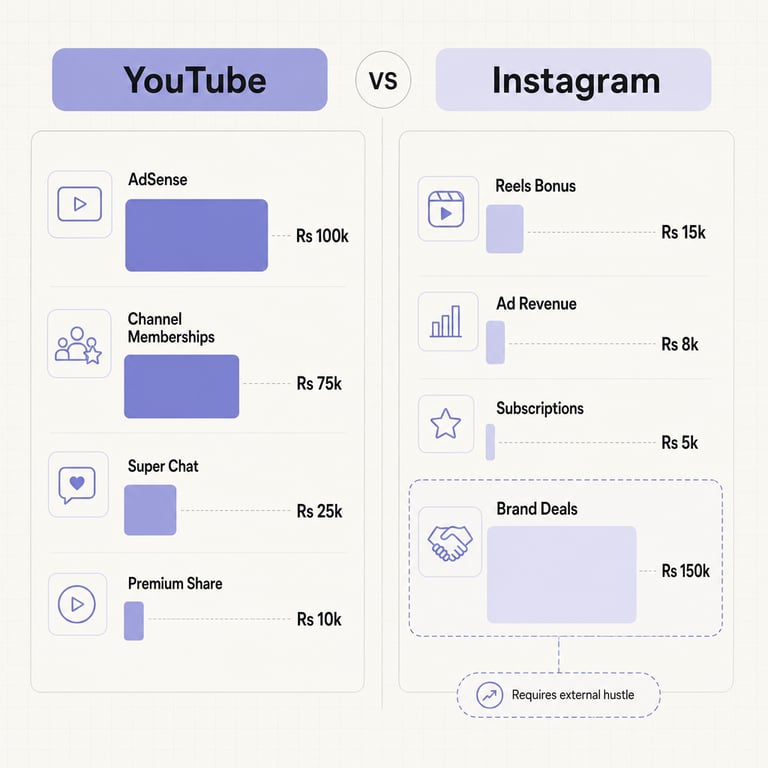
Ad revenue (AdSense): This is the baseline. In India, you earn Rs 15-150 per 1000 views depending on niche. Finance and tech hit the high end (Rs 80-150). Gaming and entertainment hit the low end (Rs 15-40). The variation is massive because advertisers pay more for viewers with higher purchasing power-a finance video attracts ads from credit cards and investment apps; a gaming video attracts cheaper gaming ads.
Channel memberships: Once you hit 1000 subscribers, you can offer channel memberships. Members pay Rs 49-499/month for badges and perks. YouTube takes 30%, you keep 70%. For a 50k-subscriber channel with 5% members, that's Rs 8,000-40,000/month on top of ad revenue.
Super Chat: During live streams, viewers send you money. Rs 1-5000 per Super Chat. Small, but it compounds across streams.
YouTube Premium revenue share: A small cut of Premium subscription fees based on watch time. Usually Rs 500-2000/month for mid-sized channels.
The math: A channel with 100k subscribers and 1M monthly views in the finance niche might earn:
AdSense: 1M views × Rs 100/1000 = Rs 100,000
Memberships: 5k members × Rs 150 average = Rs 750,000
Super Chat (live streams): Rs 30,000
Total: Rs 880,000/month
That's Rs 10.5 lakhs annually. That's sustainable in India.
Instagram's monetization doesn't come close to this structure.
Instagram monetization: The real numbers
Instagram's creator programs are fragmented and unpredictable. Here's what's actually available:
Reels Bonus Program: Meta pays Rs 200-500 per video based on Reels performance. The program is invitation-only and inconsistent. One week you qualify, next month you don't. Most creators on this program earn Rs 5,000-15,000/month even with 500k followers.
Ad revenue sharing: Instagram's audience network shares a small cut of banner and native ads. Typically Rs 1-5 per 1000 impressions. For 10M monthly impressions, that's Rs 10,000-50,000/month on a good month.
Subscriptions: Like YouTube memberships, Instagram allows subscriptions. You get 70%, Meta takes 30%. But Instagram subscriptions adoption is far lower than YouTube memberships-most Indian creators report 1-2% subscription rates.
Branded content: Instagram's native tool for brand deals. Meta doesn't pay-brands do. The rates are comparable to YouTube here.
The math: A creator with 500k followers and 10M monthly Reels impressions might earn:
Reels Bonus: Rs 10,000 (inconsistent)
Ad revenue: Rs 15,000 (if qualified)
Subscriptions: Rs 5,000 (low adoption)
Total from Meta: Rs 30,000/month
Add brand deals (Rs 50,000-200,000 per deal depending on niche), and you get to Rs 100k+/month. But that requires active brand outreach and negotiation.
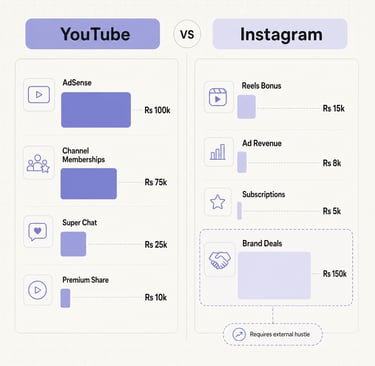
The key difference: YouTube's monetization is built in and automatic. Instagram's is fragmented, requires active hustle for brand deals, and the platform's own programs pay almost nothing.
Audience building: Where is it easier to start?
This is where Instagram wins decisively.
YouTube's algorithm is fundamentally throttled for new channels. You upload a video, and YouTube shows it to maybe 100-500 people initially. Then it waits to see if those people click, watch, and come back. If they do, YouTube pushes it harder. If they don't, it dies.
This feedback loop takes weeks. Your first 50 videos might get 1000 views total. Your 51st video-on a slightly better topic or slightly better hooks-might finally get 5k views. Slow burn.
Instagram Reels have much looser throttling. A new account posting a good Reel has a genuine shot at 10k-50k views. Not guaranteed, but real. The algorithm tests content wider and faster.
Growth speed comparison:
YouTube: 50-200 subscribers/month for a new channel (6-12 months to 1000 subscribers)
Instagram Reels: 500-2000 followers/month for a good content creator (2-4 months to 1000 followers)
Instagram is 5-10x faster for initial audience building.
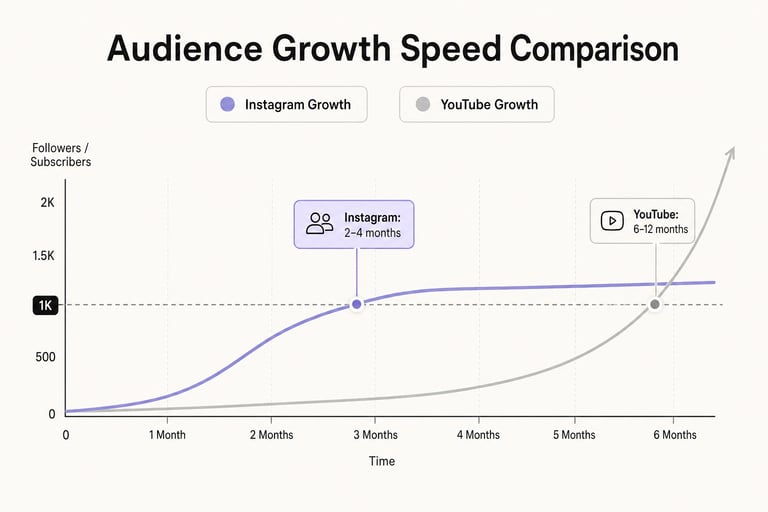
But here's the catch: Instagram's audience growth doesn't translate to sustainable income, and YouTube's slower growth compounds into real money over time.
Brand deals: Does the platform matter?
Both platforms attract brands. The rates are surprisingly similar for comparable follower counts.
A creator with 100k followers on YouTube might command Rs 50,000-150,000 per brand deal (depending on niche, engagement, and negotiation).
A creator with 100k followers on Instagram gets Rs 40,000-120,000 per brand deal.
Not that different. Brands care about audience size and engagement, not which platform you're on.
Where Instagram wins: Influencer marketing is more ingrained in Instagram culture. Brands actively hunt creators on Instagram for product launches and promotions. You can get discovered organically.
Where YouTube wins: Brand deals are higher-ticket on YouTube because audiences watch longer and engage deeper. A YouTube viewer is more "in" the creator's world than an Instagram scroller. That translates to better ad performance for brands.
Net-net: Both platforms have brand-deal ecosystems. Neither is dramatically better.
Evergreen content: Why YouTube has a 5-year advantage
This is the asymmetry that makes YouTube win long-term.
Post a video about "how to file income tax in India" on YouTube in 2026. In 2027, someone searching for that topic finds it and watches. In 2028, same thing. In 2030, it's still earning views and ad revenue.
That same video as an Instagram Reel dies after 48 hours. By next week, no one will see it.
Example: A creator posted a detailed YouTube video on "best savings accounts in India" in 2023. By 2026, that video has 500k lifetime views. It's earned Rs 75,000+ in ad revenue alone. Add in the 10,000+ subscribers it brought to the channel, and it's been the gift that keeps giving.
Post that same content as an Instagram Reel in 2026, and it gets maybe 50k views in two days, then disappears.
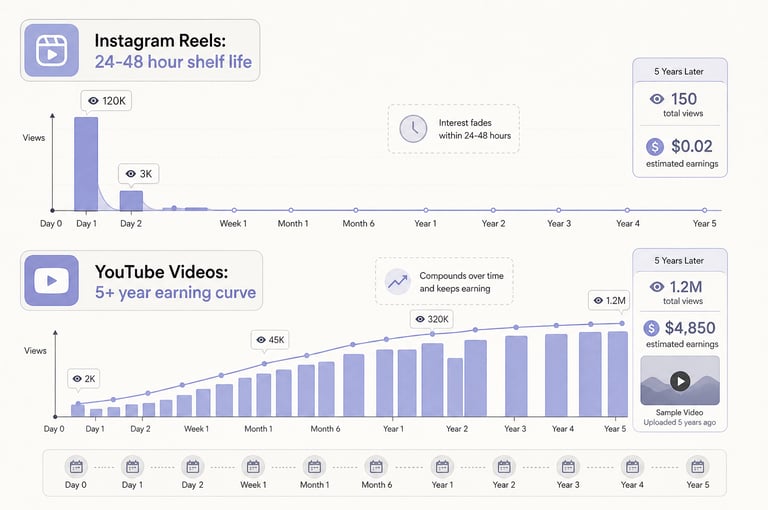
This is why YouTube channels with 5+ years of content have compounding income. Each video in that library is still working. Instagram creators have to post constantly just to maintain visibility.
For creators who want sustainable, passive income, this is massive. For creators who enjoy high-tempo posting and constant engagement, Instagram is less of a grind.
The verdict: Which should Indian creators focus on?
Here's the blunt answer: YouTube is the better platform for sustainable income. Instagram is better for rapid growth and brand deals.
If you want to build a full-time creator business in India, YouTube is your primary income vehicle. The monetization is deeper, the audience shelf life is longer, and the income compounds over time.
If you want to hit 100k followers fast and land brand deals, Instagram is faster to grow and easier to monetize through sponsorships.
Most successful Indian creators don't choose-they do both. But they allocate time differently.
For YouTube: 70-80% of your energy. This is where you build the library, optimize for watch time, and capture evergreen income.
For Instagram: 20-30% of your energy. This is where you repurpose your best content, use it as a funnel to YouTube, and maintain visibility.
The smart play: Using both without burning out
Here's how to do this without doubling your workload.
1. Write and shoot for YouTube first. Your script, your shot list, your editing-all optimized for YouTube. Longer form, better hooks, deeper value. Spend your creative energy here.
2. Repurpose aggressively. Break down your YouTube video into 3-5 Instagram Reels. The hook clip, the key insight, the surprising takeaway, the call-to-action. Post these with a link back to the full YouTube video.
3. Treat Instagram as a discovery funnel. The Reel drives people to your YouTube channel. Your YouTube channel is where they subscribe, binge your back catalog, and become long-term income.
4. Invest in YouTube first, Instagram second. New microphone? YouTube gets it. Lighting setup? YouTube first. Why? Because YouTube's monetization compounds; Instagram's doesn't.
5. Batch your posting. Film 4 weeks of YouTube content in one session. Edit one at a time, publish weekly. Extract Reels as you go. This is faster than posting to both platforms ad-hoc.
Example workflow:
Monday: Film 4 YouTube scripts (12 hours of shooting)
Tuesday-Thursday: Edit and optimize for YouTube (12 hours)
Friday: Extract and post 12-16 Instagram Reels from the 4 videos (4 hours)
Ongoing: YouTube videos publish weekly; Instagram Reels go out daily or every other day
Total time: 28 hours to create content that sustains both platforms for a month. That's 7 hours/week on average. Not light, but sustainable.
Cross-platform strategy: The real competitive edge
The meta-insight: YouTube and Instagram aren't really competitors. They're sequential.
Instagram gets people's attention. YouTube keeps it.
A creator who uses Instagram Reels to drive YouTube subscribers will build an audience 3-4x faster than someone doing YouTube alone. The Reels generate discovery; the YouTube channel captures and monetizes it.
In 2026, the winning creators in India are doing this:
Posting 5-8 Instagram Reels per week (repurposed from YouTube content)
Publishing 1-2 YouTube videos per week (original, longer-form)
Using Instagram as a funnel, YouTube as the income engine
This approach gives you the best of both worlds: Instagram's reach velocity and YouTube's monetization depth.
Frequently Asked Questions
Can I make a full-time income from Instagram Reels alone in India?
No. Instagram Reels monetization in India is inconsistent and extremely low. Most creators earn under Rs 500/month from Reels alone, even with 100k+ followers. Full-time income requires combining Instagram with brand deals or YouTube.
How long does it take to build 1000 subscribers on each platform?
YouTube typically takes 6-12 months for new channels in India. Structured growth strategies can accelerate this. Instagram Reels can hit 1000 followers in 2-4 months with viral content, but watch time and monetization still lag YouTube significantly.
Is YouTube's algorithm really slower for new creators?
Yes. YouTube prioritizes watch time and viewer history, so new channels get limited initial reach. Instagram Reels have higher algorithmic reach initially, making early growth faster. However, YouTube's content shelf life-videos get recommended for months or years-more than compensates over time.
Should I post the same content on both platforms?
No. Repurpose strategically: post short Reels/Shorts as teasers that link to your YouTube channel. Use Instagram as a funnel to YouTube, not a parallel income stream. YouTube is your primary earner; Instagram is discovery and audience building.
What niche actually makes money on YouTube in India?
Finance, tech, and educational content earn Rs 30-150 per 1000 views. Gaming and entertainment earn Rs 15-40 per 1000 views. CPM varies wildly by audience demographics and content. YouTube algorithm optimization matters more than niche alone-pick what you can sustain.
Try ytverse.in
Building audience on YouTube is harder than it looks. Algorithm changes, niche saturation, audience fatigue-these kill most channels before they hit 1000 subscribers.
Ytverse.in specializes in helping Indian creators solve this. They work with the YouTube algorithm directly, not guessing. If you're serious about YouTube growth, they've already helped hundreds of creators hit monetization milestones and build sustainable income. Worth exploring if you're tired of slow growth.
The final take: If you've got a choice, pick YouTube. If you can do both, even better. And use Instagram to funnel people to YouTube-that's where the real money compounds.